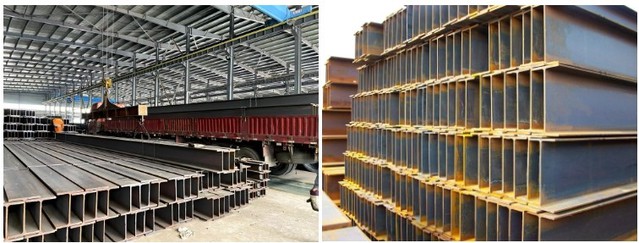
Gnee Steel (Tianjin) Co., Ltd. is one of the most professional hot rolled structural steel h beam s355jr hem280 manufacturers and suppliers in China, also supports customized service. If you're going to buy hot rolled structural steel h beam s355jr hem280 made in China, welcome to get free sample from our factory. Quality products and low price are available.
Hot Rolled Structural Steel H Beam S355JR HEM280
The cross-sectional dimensions of HEM280 structural h beam are: height (H) is 310 mm; flange width (B) is 288 mm; web thickness (t₁) is 18.5 mm; flange thickness (t₂) is 33 mm.
S355JR structural steel h beam belongs to the European standard low-alloy high-strength structural steel, which complies with the EN 10025-2 standard. The chemical composition of S355JR h beam material: carbon (C) ≤0.22%, manganese (Mn) ≤1.60%, phosphorus (P) ≤0.035%, sulfur (S) ≤0.035%, with good weldability and toughness.
The yield strength of S355JR h-beam steel structure varies with thickness. It is 355 MPa when the thickness is ≤16 mm, and gradually decreases with increasing thickness (such as 345 MPa when the thickness is 16-40 mm); the tensile strength is 470-630 MPa. The impact toughness is ≥27 J at +20℃.
Construction engineering: suitable for structural components with high bearing capacity such as bridges and high-rise buildings.
Machinery manufacturing: used for components such as cranes and construction machinery that need to resist fatigue and impact.
Other fields: scenes with high requirements for corrosion resistance and strength such as vehicle manufacturing and marine engineering.
Application areas of HEM280 (S355JR beam steel)
Building structure: used in high-rise building frames, main beams of industrial plants, roof supports of stadiums and other scenes, bearing vertical and horizontal loads.
Bridge engineering: suitable for the main structure of bridges, bridge deck pavement and span beams, bearing dynamic loads of vehicles and natural environment.
Machinery manufacturing: manufacturing heavy machinery parts such as crane booms, excavator chassis, and mining equipment brackets to meet high strength and fatigue resistance requirements.
Marine engineering and ships: as components such as hull decks, bulkheads, and offshore platform trusses, resisting seawater corrosion and wave impact.
Energy and industrial equipment: used in energy equipment such as wind power towers and hydraulic supports to withstand stress under complex working conditions.
Transportation: used in truck frames, railway bridge components and vehicle suspension systems to ensure transportation safety and reliability.