





Channel Steel
What Is Channel Steel
Channel steel is a cross-section of the groove-shaped strip of steel, it's a kind of carbon structural steel that belongs to a construction and mechanical use.It is a complex cross-section of the steel section, whose cross-sectional shape is groove-shaped. Channel steel is mainly used for building structures, curtain wall engineering, machinery and equipment and vehicle manufacturing.

| Standard | Grade |
|---|---|
| GB/T 706 | Q195, Q215, Q235B, Q235C, Q275, Q355B, Q355C, Q355D |
| GB/T 11263 | Q235B, Q355B, Q355C, Q355D |
| ASTM A36 | A36 |
| ASTM A572 | Grade 42, Grade 50, Grade 55, Grade 60, Grade 65 |
| ASTM A588 | Grade A, Grade B, Grade K |
| ASTM A242 | Type 1, Type 2 |
| ASTM A992 | A992 |
| ASTM A529 | Grade 50, Grade 55 |
| ASTM A709 | Grade 36, Grade 50, Grade 50W |
| EN 10025-2 | S235JR, S275JR, S355JR, S355J0, S355J2 |
| EN 10025-5 | S235J0W, S355J0W, S355J2W, S355K2W |
| EN 10210 | S235JRH, S275J0H, S355J2H |
| JIS G3101 | SS400 |
| JIS G3106 | SM400A, SM400B, SM490A, SM490B, SM490YA, SM570 |
| JIS G3114 | SMA400AW, SMA400BW, SMA490AW, SMA490BW |
GB/T 706-2016 Standard Channels
| Size | Height H (mm) | Flange Width B (mm) | Flange Thickness t (mm) | Weight (kg/m) |
|---|---|---|---|---|
| 5# | 50 | 37 | 4.5 | 5.44 |
| 6.3# | 63 | 40 | 4.8 | 6.63 |
| 8# | 80 | 43 | 5.0 | 8.04 |
| 10# | 100 | 48 | 5.3 | 10.0 |
| 12# | 120 | 53 | 5.5 | 12.3 |
| 14# | 140 | 58 | 6.0 | 14.5 |
| 16# | 160 | 63 | 6.5 | 17.2 |
| 18# | 180 | 68 | 7.0 | 20.2 |
| 20# | 200 | 73 | 7.0 | 22.7 |
| 22# | 220 | 77 | 7.5 | 25.8 |
| 25# | 250 | 78 | 7.5 | 27.9 |
| 28# | 280 | 82 | 8.0 | 31.4 |
| 30# | 300 | 85 | 8.5 | 34.5 |
| 32# | 320 | 88 | 9.0 | 38.0 |
| 36# | 360 | 96 | 10.0 | 47.0 |
| 40# | 400 | 100 | 10.5 | 56.0 |
EN 10365 / EN 10079 Standard Channels
UPN Series (Standard Channels)
| Size | Height H (mm) | Flange Width B (mm) | Flange Thickness t (mm) | Weight (kg/m) |
|---|---|---|---|---|
| UPN 50 | 50 | 38 | 5.0 | 5.0 |
| UPN 65 | 65 | 42 | 5.5 | 7.1 |
| UPN 80 | 80 | 45 | 6.0 | 8.6 |
| UPN 100 | 100 | 50 | 6.0 | 10.6 |
| UPN 120 | 120 | 55 | 7.0 | 13.4 |
| UPN 140 | 140 | 60 | 7.0 | 16.0 |
| UPN 160 | 160 | 65 | 7.5 | 18.8 |
| UPN 180 | 180 | 70 | 8.0 | 22.0 |
| UPN 200 | 200 | 75 | 8.5 | 25.3 |
| UPN 220 | 220 | 80 | 9.0 | 29.4 |
| UPN 240 | 240 | 85 | 9.5 | 33.2 |
| UPN 260 | 260 | 90 | 10.0 | 37.9 |
| UPN 300 | 300 | 100 | 10.5 | 46.2 |
UPE Series (Lightweight Channels)
| Size | Height H (mm) | Flange Width B (mm) | Weight (kg/m) |
|---|---|---|---|
| UPE 80 | 80 | 46 | 6.0 |
| UPE 100 | 100 | 50 | 8.0 |
| UPE 120 | 120 | 55 | 10.4 |
| UPE 140 | 140 | 60 | 12.9 |
| UPE 160 | 160 | 65 | 15.3 |
| UPE 180 | 180 | 70 | 18.0 |
| UPE 200 | 200 | 75 | 20.9 |
ASTM Standard Channels
| Size | Height H (in/mm) | Flange Width B (in/mm) | Weight (lb/ft / kg/m) |
|---|---|---|---|
| C3×4.1 | 3.00 / 76 | 1.498 / 38 | 4.1 / 6.1 |
| C4×5.4 | 4.00 / 101 | 1.584 / 40 | 5.4 / 8.0 |
| C5×6.7 | 5.00 / 127 | 1.750 / 44 | 6.7 / 9.9 |
| C6×8.2 | 6.00 / 152 | 1.920 / 49 | 8.2 / 12.1 |
| C7×9.8 | 7.00 / 178 | 2.260 / 57 | 9.8 / 14.5 |
| C8×11.5 | 8.00 / 203 | 2.330 / 59 | 11.5 / 17.1 |
| C9×13.4 | 9.00 / 229 | 2.500 / 64 | 13.4 / 19.9 |
| C10×15.3 | 10.00 / 254 | 2.660 / 68 | 15.3 / 22.7 |
| C12×20.7 | 12.00 / 305 | 3.170 / 81 | 20.7 / 30.8 |
| C15×33.9 | 15.00 / 381 | 3.940 / 100 | 33.9 / 50.5 |


Types of Channel Steel
U Channel Steel
U-shaped channel steel, also known as U-channel or simply channel, is a type of structural steel with a U-shaped cross-section.
It is commonly used in construction and engineering applications requiring strength, durability, and versatility.
The U-shaped design provides increased structural stability and load-bearing capacity, making it suitable for various uses.
C Channel Steel
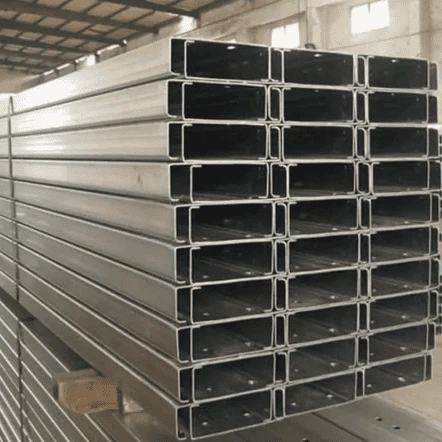
C Channel Steel generally refers to a type of cold-formed steel section with a cross-section shaped like the letter “C”.
It is mainly used in steel structure buildings as purlins and wall beams, as well as in photovoltaic systems and seismic support systems.
It has significant differences from traditional hot-rolled channel steel in both appearance and application.


Hat Channel Steel
This steel channel has two horizontal outward flanges, and two vertical flanges, which create an image similar to a hat.
Their shape makes them excellent for roof framing.
J Channel Steel
This shape is achieved by making one of the steel channel’s sides longer than the other.
They come in a wide range of sizes and can be tailored to meet specific project needs.
The most common forms of a J channel include hemless channels, hemmed channels, and those with a flat part that can be screwed or nailed on.
Product Center

Walls
Steel channels are used like studs in metal buildings (garages, warehouses, workshops) to support vertical loads.
They are much stronger and more rigid than wood studs, though installation requires welding, bolting, or riveting.

Pole Barn Walls
Steel channels are used in pole barns as horizontal members between poles to support exterior siding and interior finishes like drywall. Compared to wood, they allow wider spacing between poles and provide better stability, avoiding warping, twisting, and uneven walls over long spans.

Window And Door Frames
Steel channels are used to create strong window and door frames in metal or wood buildings.
They provide a flat, secure surface for mounting doors or windows and are commonly used for commercial fire doors and basement doors.

Wood Beam Supports
Steel channels are used to reinforce wood-framed structures by increasing beam strength and rigidity.
They can be fitted around or attached to wooden beams to improve load capacity during construction or remodeling, while still allowing easy connection of other structural components.

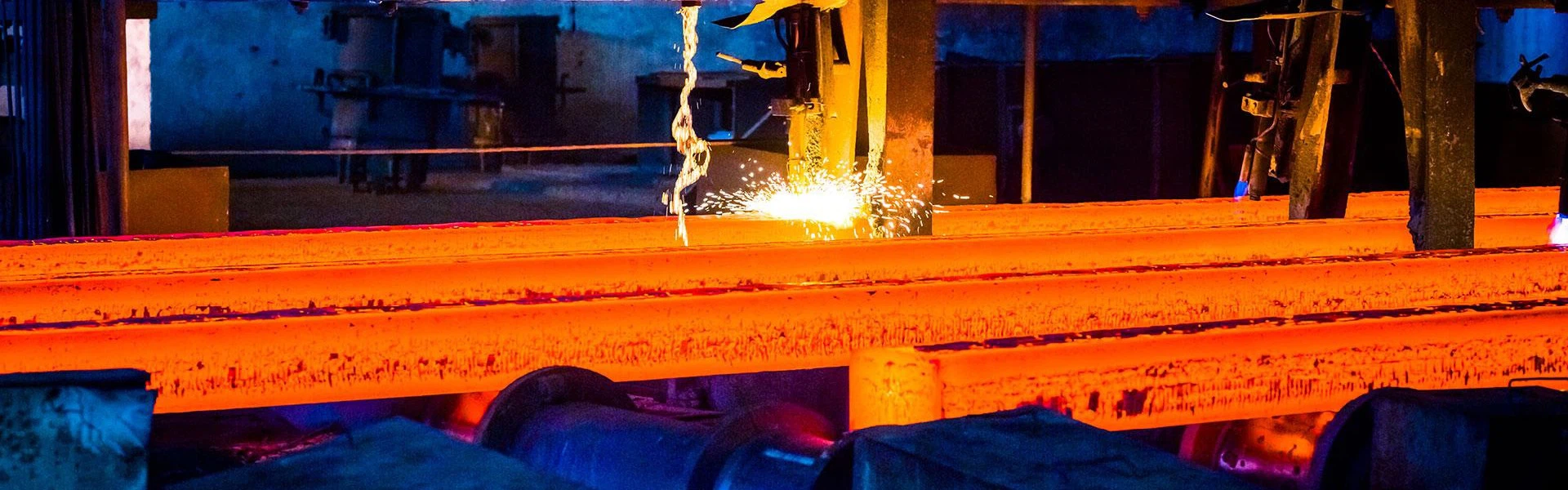
Steel channels are usually made from hot-rolled mild steel. In this process, a metal strip is fed through a series of rollers - also known as supports. This distorts the strip until the desired shape and form are created. After the shaping is completed, the rolled form is cut to the required length.
The process of creating steel channels is generally quick and low-cost. Steel channels also don’t require any extra processing or finishing steps. This allows steel channels to be mass-produced at an affordable price.
There are cases where steel channels will be subjected to extra fabrication steps after being hot-rolled. They can be galvanized after fabrication to improve their durability and corrosion resistance. They can also be drilled or machined to fit the precise specifications of the project. Lastly, they can be welded to create larger or custom forms.
When connecting channel steel, various types of fasteners can be used depending on the specific application, load requirements, and environmental conditions. Here are some common types of fasteners used to connect channel steel:
Welding: The most common method for connecting channel steel is welding. Welding provides a strong, permanent joint that can withstand high loads. Arc welding, MIG (Metal Inert Gas) welding, and TIG (Tungsten Inert Gas) welding are common types of welding used for joining channel steel.
Bolts and Nuts: Bolts and nuts are used when a removable or adjustable connection is needed. High-strength bolts with washers are typically used to connect channel steel, and sometimes a gasket might be used between the parts to prevent leaks if the connection is exposed to fluids or gases.
Self-tapping Screws: These screws have a tapered tip that creates its own threads as it is driven into the channel steel. They are often used for light-duty connections and are convenient for attaching sheet metal or other thinner materials to channel steel.
Hex Bolts: Hex bolts come with a hexagonal head and are used with a nut to provide a strong connection. They can be used in various applications, including those where the connection may need to be disassembled.
Socket Screws: These screws have a hex socket in the head and are driven with a wrench or socket wrench. They can be used for medium-duty applications where a secure connection is needed.
Countersunk Screws: These screws have a tapered head that allows the head to sit flush with the surface of the material. They are commonly used where a smooth finish is required.
Rivets: Rivets are used to create a permanent, strong joint. They are often used in applications where the joint needs to be particularly strong or where there is a need for vibration dampening.
Clamps and Straps: Metal clamps or straps are used to hold channel steel parts together, often in conjunction with bolts and nuts for a secure connection.
When selecting fasteners for connecting channel steel, it's important to consider the following factors:
Load Bearing Capacity: The fastener must be able to support the expected loads without failing.
Environment: The environment, such as exposure to moisture, chemicals, or high temperatures, can affect the choice of fastener.
Movement: If the joint is expected to experience movement or vibration, a flexible fastener or one designed to allow for slight movement may be necessary.
Corrosion Resistance: Fasteners made of stainless steel or coated with corrosion-resistant materials may be required for outdoor or harsh environments.
How do Channel Steels compare to angle iron
Channel steels and angle irons are both structural steel products commonly used in construction and manufacturing due to their strength and versatility. there are differences in their shape, size, and application.
Channel steel, also known as a C-channel because of its cross-sectional profile resembling the letter "C," comes in various sizes and specifications. It has a flat surface on the top and bottom with edges that are parallel to each other. Channel steels are typically used when a structure requires a lot of vertical support or needs to withstand a significant amount of weight above it. For instance, they may be used in framing buildings, constructing bridges, or supporting heavy machinery.
Angle iron, on the other hand, has a cross-section that resembles the letter "L," hence its name. Angle irons are available in various sizes and angles, usually between 0 degrees and 90 degrees. They are primarily used for connecting and bracing structures where lateral support is needed. For example, angle irons are often used to provide support for beams, create frames, reinforce concrete, or as part of a railing system.
The choice between channel steel and angle iron depends on the specific requirements of the project, including load capacity, structural design, and the need for bending or twisting resistance. Channel steel tends to offer better support for loads applied directly above it, while angle iron provides better resistance to bending and torsional forces. Both materials can be welded, bolted, or connected using other fasteners, depending on the application.
In terms of strength, the properties of both channel steel and angle iron are determined by factors such as the material's grade, cross-sectional area, and the thickness of the steel. When comparing the same material grade and dimensions, the strength will generally be similar, but the way the force is distributed along the length and across the section will differ due to their distinct shapes.
What Are The Storage Requirements For Channel Steels
Channel steels, like many other structural steel products, need to be stored in a manner that protects them from environmental damage during the time between manufacturing and installation. The storage requirements for channel steels include the following considerations:


Protection from the Elements: Channel steels should be kept indoors or under a covered area to protect them from rain, snow, and excessive moisture. If outdoor storage is unavoidable, the steels should be adequately tarped or covered to prevent exposure to precipitation.
Stacking: When stacking channel steels, they should be placed on leveled ground or pallets to prevent warping or bending due to uneven weight distribution. Stacks should be limited to appropriate heights to ensure safety and stability.
Separation: To prevent corrosion, channel steels should be separated from each other by spacers or strips of wood or plastic. Direct contact between steel surfaces can lead to galvanic corrosion.
Ventilation: If channel steels are stored indoors, the storage area must be well-ventilated to avoid condensation buildup, which could lead to rust.
Cleanliness: The storage area should be clean, free from debris, and prevent contaminants from coming into contact with the steel surfaces. Regular sweeping and cleaning of the storage area are necessary.
Temperature Control: Extreme temperatures can affect the metallurgical properties of the steel. While channel steels are generally robust and can withstand temperature variations, avoiding prolonged exposure to very high or low temperatures is advisable.
Labeling and Organization: Proper labeling and organization help in managing inventory and preventing mix-ups. Each stack of channel steels should be clearly labeled with information such as grade, size, length, and batch number.
Security: The storage area should be secure against theft and unauthorized access.
Channel steel dimensions are usually measured in terms of height (h), width (b), and thickness (d). The height is the vertical dimension of the channel steel, the width is the horizontal dimension, and the thickness is the dimension of the steel plate.
To measure the dimensions of channel steel, you can use a ruler, caliper, or other measuring tools. Measuring tools should be calibrated to ensure accuracy. Typically, the dimensions are measured at the specified measurement points on the channel steel, such as the top, bottom, and sides.
It is important to note that the dimensions of channel steel may have certain tolerances, and the specific tolerance range may vary depending on the standard or specification requirements. Therefore, when measuring channel steel dimensions, it is necessary to refer to the relevant standards or specifications to ensure measurement accuracy.
In addition, if the dimensions of the channel steel need to meet more precise requirements, it may be necessary to use professional measuring equipment or techniques, such as coordinate measuring machines or optical measurement methods. These methods can provide more accurate and detailed dimension measurement results.
When purchasing or using channel steel, it is recommended to clearly understand and confirm the dimension requirements and tolerances with suppliers or manufacturers to ensure that the channel steel meets the expected specifications.
What Are The Design Considerations When Using Channel Steels
When designing with channel steels, several considerations should be taken into account to ensure the structural integrity and functionality of the application. Here are some key design considerations:
Load Bearing Capacity: One of the primary considerations is the load that the channel steel will need to bear. This includes dead loads (permanent loads such as the weight of the structure itself), live loads (temporary loads such as occupancy or equipment), and any additional loads such as snow, wind, or earthquakes.
Deflection Limits: Deflection of the beam under load is an important consideration, especially for aesthetic reasons and to ensure the functionality of the structure. Deflection limits are typically governed by building codes and must be calculated to ensure the beam will not exceed these limits.
Connection Details: The way channel steels will be connected to other members of the structure is crucial. This includes the use of bolts, welds, or other joining methods and the design of the connections to distribute loads effectively.
Stress and Strain: The design must ensure that the steel does not reach its yield point or ultimate tensile stress. The cross-sectional area of the channel must be sufficient to resist the applied loads without failing.
Material Selection: The grade and quality of the steel are important. High-quality steels with good strength and toughness characteristics will offer better performance and durability.
Corrosion Protection: Depending on the environment, corrosion protection may be necessary. This could involve selecting a galvanized or coated steel, or incorporating protective coatings after fabrication.
Fire Resistance: In cases where the structure will be exposed to high temperatures or there is a risk of fire, the fire resistance of the channel steel should be considered.
Serviceability Requirements: This includes factors such as vibration, durability, and maintenance. The design should consider the long-term serviceability of the steel.
Cost and Availability: The cost and availability of the channel steel should also be considered, as this can impact the overall project budget and timeline.
Fatigue and Repeated Loading: For applications where there will be repeated loading, such as in bridges or structures subject to frequent vibrations, the effects of fatigue should be considered.
How Do You Install Channel Steels In a Building
Here is a typical step-by-step process for installing channel steels in a building:
Design Planning
Before installation begins, engineers will design the structure, determining where the channel steels need to be placed and their specifications (such as size, grade, and length) based on load requirements and architectural plans
Fabrication
The channel steels are cut to the appropriate lengths and any necessary holes are drilled for bolting or other connections. Pre-fabrication may also involve welding or assembling the channel steels into frames or trusses.
Layout
On-site, workers will layout the positions of the channel steels according to the design plan, ensuring they are level and plumb.
Erection
Using cranes, hoists, or other lifting equipment, the channel steels are lifted into place. Workers guide them into position and temporarily secure them using braces or shores.
Attachment
The channel steels are permanently attached to other structural members or to the foundation. This is usually done using high-strength bolts, welding, or other connectors.
Bracing
Once the channel steels are in place, they are braced to ensure they remain stable during the rest of the construction process. This can involve diagonal bracing, tension cables, or other methods.
Inspection
After installation, a qualified inspector must check the work to ensure that the channel steels are properly aligned, connected, and meet all structural safety codes and standards.
Secondary Structure
The installed channel steels can then serve as supports for floors, roofs, walls, or other secondary structures. This may involve additional framing, sheathing, and finishing.
Maintenance Tips for Channel Steel
Here are some tips for maintaining channel steel:
Protection Against Corrosion: Regularly inspect the steel for signs of rust or corrosion. Early detection allows for prompt treatment to prevent further deterioration. Applying a coat of primer or paint can help protect the steel from moisture and corrosive elements.
Lubrication: If the channel steel is part of a moving structure or mechanism, ensure that all moving parts are properly lubricated. This reduces friction and wear and helps prevent rust from forming on the metal surfaces.
Regular Cleaning: Dust, dirt, and other debris can accumulate on the steel surfaces, leading to corrosion over time. Use a mild detergent and non-abrasive cleaning tools to clean the steel. Rinse thoroughly to remove any cleaning residue.
Avoid Harsh Chemicals: When cleaning the steel, avoid using strong acidic or alkaline cleaners, as these can damage the protective coatings and lead to corrosion.
Protective Coatings: Reapply protective coatings such as paint or galvanization as they wear off or if damage occurs. This provides an additional barrier against the environment.
Protective Coatings: Reapply protective coatings such as paint or galvanization as they wear off or if damage occurs. This provides an additional barrier against the environment.
Inspection: Periodically inspect the channel steel for structural integrity. Check for cracks, bends, or other signs of damage that might compromise its load-bearing capacity.
Environmental Considerations: If the steel is exposed to extreme environments, such as high humidity, saltwater air, or industrial pollutants, it may need more frequent inspections and maintenance.
Stress Relief: After welding or other heat-inducing processes, consider stress relief treatments to minimize internal stresses that could lead to cracking or distortion.
Our Factory
GNEE (Tianjin) Multinational Trading Co., Ltd. is located in Anyang City, Henan Province, China, is a comprehensive, modern, high quality enterprise integrating steel production, processing and sales. GNEE specialises in the production of heavy duty H-beams, all types of section products, hot rolled steel plates, seamless steel pipes, welded steel pipes, stainless steel tubes, plates, coils and fittings, flanges, etc. A one-stop-shop service company.
FAQ
Gnee Steel (Tianjin) Co., Ltd. is one of the leading channel steel manufacturers and suppliers in China. We warmly welcome you to buy high-grade channel steel for sale here and get free sample from our factory. All customized products are with high quality and low price.
Stainless Channel Section, c shaped steel, uv resistance channel steel