


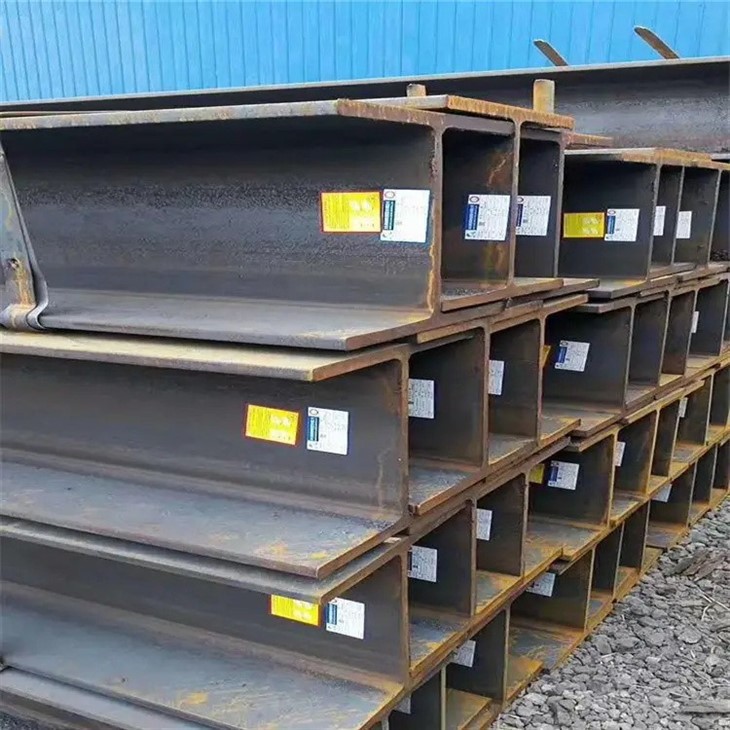
Products Description
The standard-making party is different from that A36 is the material of American standard ASME standard (equivalent to ASTM specification), SS400 is the material of Japanese standard JIS G3101 (rolled steel for common structure), and Q235 is the material of national standard GB700. GB700: Q235 JIS G3101: SS400 ASME: A36
Comparison table of chemical composition of materials with different A36, SS400 and Q235 chemical composition. Steel grade chemical composition mass fraction (%) C (≤) Mn (≤) Si (≤) S (≤) P (s) Cu (≤)
< > ASTMA36 0.26 0.40 0.050 0.040 0.2 min
CHINAQ235-A 0.14~0.22 0.3~0.65 0.30 0.050 0.045
CHINAQ235-B 0.12~0.20 0.30~0.70 0.30 0.045 0.045
JISSS400-- 0.050 0.050
H beams and I beams are two different types of structural steel members that are commonly used in construction. The distinguishing feature between them is their shape. An H beam is shaped like the letter "H" with one vertical flange and two long-side flanges, whereas an I beam has a cross-section that resembles the letter "I" with a single vertical web or web thickest at mid-span, two webs, and no bottom flange.
These steel members have similar mechanical properties but differ in dimensional characteristics.
H-beams are more efficient than I-beams because they are better at carrying bending and shear loads. H-beams have a thicker, deeper web, which means that they can better support the weight of an object placed on top of them. This also helps balance out any cantilevered loads that might be placed on an H-beam in the future (such as additional floors or beams). In addition to having greater section modulus – which means that they are able to resist compression forces better than I-beams do – they also have greater tensile strength values, meaning that they're less likely to bend under pressure from tension forces acting upon them.
To short, the main difference between an H-beam and an I-beam is that the web of an H-beam is much thicker than that of an I-beam. A thicker web means a stronger beam, which allows for more load-bearing capacity. This means that for the same amount of structural support, you can use fewer H beams than I beams.
Another difference between these two types of beams is that instead of being straight up and down like in the case with most other types of beams (such as T or L), H beams are curved outwards at both ends to create flanges and webs that run parallel to each other along their length. This structure makes them particularly suited for carrying bending loads-that means they're great if you need one piece of wood or metal to bend slightly while staying stiff but flexible throughout its length-and also helps them carry shear loads more efficiently than any other type because they distribute stress evenly over their entire length rather than concentrating it at one end where it could snap off easily due to fatigue failure).

Product Details
| Product Name | Q235 SS400 steel h beam |
| Length | As your required |
| Standard | ASTM/ GB/ JIS/ EN ect. |
| Delivery Time | According to your quantity |
| Payment Terms | FOB/ CIF/ EXW/ DDP |
| Origin | China |
| Sample | Yes |
| Tolerance | ±0.3 |
| Packing | Packed with steel belts tightly, in bundle |
GNEE Group Receives Visiting Customers

We are experts in the supplying of materials to meet the individual requirements of a project, regardless of size, scope or difficulty. As a specialized supplier of highly qualified products such as Seamless/Welded Pipe and Tube, Plate and Equipment for industries such as Pressure Vessel, Heat Exchanger. We mainly service for industry of Oil & Gas, Petrochemical, Power Generation, Onshore & Offshore and other industry and energy field over the world.The services and support we provide are tailored to the needs of a particular customer and project, and are driven by in-depth knowledge of the products, and we are aware of the importance of high quality, on-time delivery and the pressures of meeting fabrication schedules, and also the importance of accurate and up-to-date reporting.Since our establishment, we have been servicing our customers and the projects in Canada, South America, Southeast Asia, Central Asia, Middle East, South Africa, North Africa and North Europe market.