


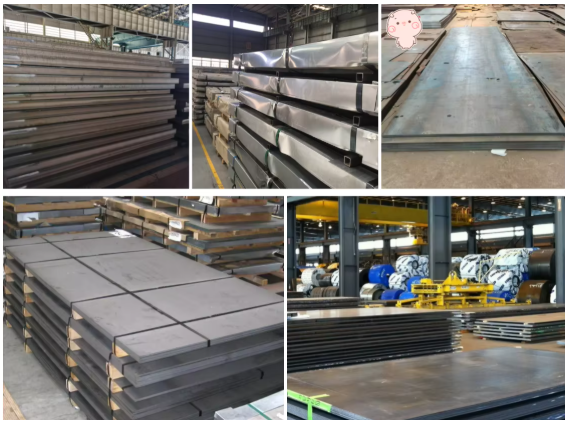
ASTM A387 Grade 11 alloy steel plates are chromium-molybdenum (Cr-Mo) alloy steel plates designed for pressure vessels, boilers, and high-temperature service applications.

ASTM A387 Grade 11 alloy steel plates
These steel plates are commonly used in petrochemical, power generation, and chemical processing industries due to their excellent high-temperature strength, corrosion resistance, and weldability.
Chemical Composition of ASTM A387 Grade 11 alloy steel plates
Both ASTM A387 Grade 11 Class 1 and Class 2 share the same chemical composition requirements. The composition is carefully controlled to balance strength, toughness, and high-temperature performance.
| Element | Carbon (C) | Manganese (Mn) | Phosphorus (P) | Sulfur (S) | Silicon (Si) | Chromium (Cr) | Molybdenum (Mo) |
|---|---|---|---|---|---|---|---|
| Max % (Heat Analysis) | 0.05–0.17 | 0.40–0.65 | 0.025 | 0.025 | 0.50–0.80 | 1.00–1.50 | 0.45–0.65 |
Mechanical Properties of ASTM A387 Grade 11 alloy steel plates
The key distinction between Class 1 and Class 2 is tensile strength and yield strength, while other mechanical properties remain similar.
| Steel Plate | Yield Strength (MPa) | Tensile Strength (MPa) | Elongation (%) |
|---|---|---|---|
| ASTM A387 Grade 11 Class 1 | 240 | 415–585 | 19–22 |
| ASTM A387 Grade 11 Class 2 | 310 | 515–690 | 18–22 |
Heat Treatment of ASTM A387 Grade 11 alloy steel plates
ASTM A387 Grade 11 alloy steel plates are supplied in various heat-treated conditions to achieve required mechanical performance:
- Annealing – to relieve internal stresses and improve machinability
- Normalizing and tempering – to refine grain structure and improve toughness
- Accelerated cooling from austenitizing temperature (air blast or quench) followed by tempering
- Minimum tempering temperature: 1150°F (620°C)
These treatments ensure uniform microstructure, enhanced creep resistance, and stable mechanical performance under high temperatures.
Physical and Processing Properties of ASTM A387 Grade 11 alloy steel plates
- Good weldability with standard welding methods
- High-temperature strength for service up to 600°C (depending on design)
- Excellent forming and machining performance
- Stable performance under thermal cycling and pressure loading
Applications of ASTM A387 Grade 11 alloy steel plates
ASTM A387 Grade 11 alloy steel plates are widely used in:
| Industry | Typical Applications |
|---|---|
| Petroleum & Petrochemical | Pressure vessels, reactors, distillation columns, heat exchangers |
| Power Generation | Boilers, steam drums, superheaters |
| Chemical Processing | Chemical equipment, process vessels, storage tanks |
| General Engineering | Welded high-temperature pressure vessels, high-pressure piping |
ASTM A387 Grade 11 alloy steel plate ensures safety and reliability under high pressure and elevated temperature conditions.
Standards and Equivalent Grades
Main Standard: ASTM A387 (Specification for Pressure Vessel Plates, Alloy Steel, Chromium-Molybdenum)
Equivalent Grades:
- JIS G3116 SG345 (Japan)
- EN E355 (Europe)
Corresponding high-strength pressure vessel steel grades in other standards
- Material Type: Chromium-Molybdenum alloy steel plate
- Classes: Class 1 (moderate strength) / Class 2 (high strength)
- Properties: High tensile and yield strength, good elongation, excellent high-temperature performance
- Applications: Pressure vessels, boilers, petrochemical equipment, and high-pressure industrial equipment
ASTM A387 Grade 11 alloy steel plates are the ideal choice for welded pressure vessels and boilers, offering reliable performance under high temperatures and pressures.
If you are sourcing ASTM A387 Grade 11 steel plates, provide your required specifications such as thickness, width, quantity, and application. A detailed quotation and technical support can be arranged to meet your project requirements.
Contact now to get A387 Steel Quote
What is A387 material?
The ASTM A387 specification is the Standard Specification for Pressure Vessel Plates, Alloy Steel, Chromium-Molybdenum plates used in the application of welded boilers and pressure vessels subjected to elevated temperatures. The two grades SSAB produces are available as Class 1 and/or Class 2.
What is a A387 steel equivalent to?
Other designations that are equivalent to AISI A387 grade 22-PVQ alloy steel include the following: ASTM A182 (F22-1) ASTM A199 (T22)
What is A387 grade 22 material?
ASTM A387 Grade 22 (ASME SA387 Grade 22) is Chrom-Moly steel plate used for making boilers and pressure vessles designed for high temperature high pressure serivce, chrome content at 2.00% to 2.50%, and Moly 0.90% to 1.10% for SA387 GRADE 22 material.
What is the chemical composition of ASTM A387 Grade 12?
ASTM A387 GR 12 CL 2 Plates is designed with chemical components such as silicon, chromium, vanadium, molybdenum, sulfur, phosphorus, carbon, and manganese. Alloy Gr 12 has some tensile requirements, such as tensile strength, area reduction, elongation, and yield strength.
What is the difference between ASTM A182 and A387?
Both ASTM A182 grade F11 class 2 and ASTM A387 grade 22 steel are iron alloys. They have a very high 99% of their average alloy composition in common. There are 32 material properties with values for both materials. Properties with values for just one material (1, in this case) are not shown.