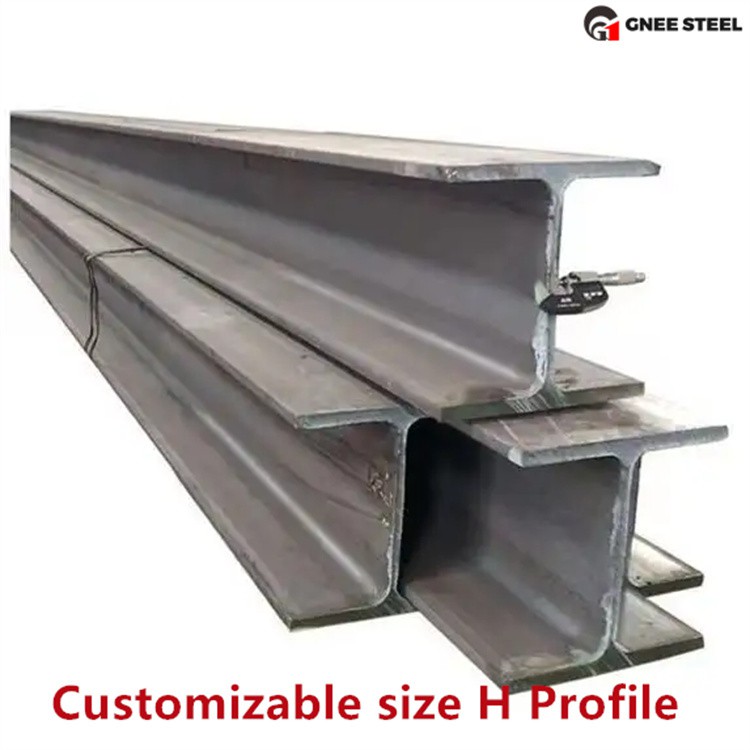
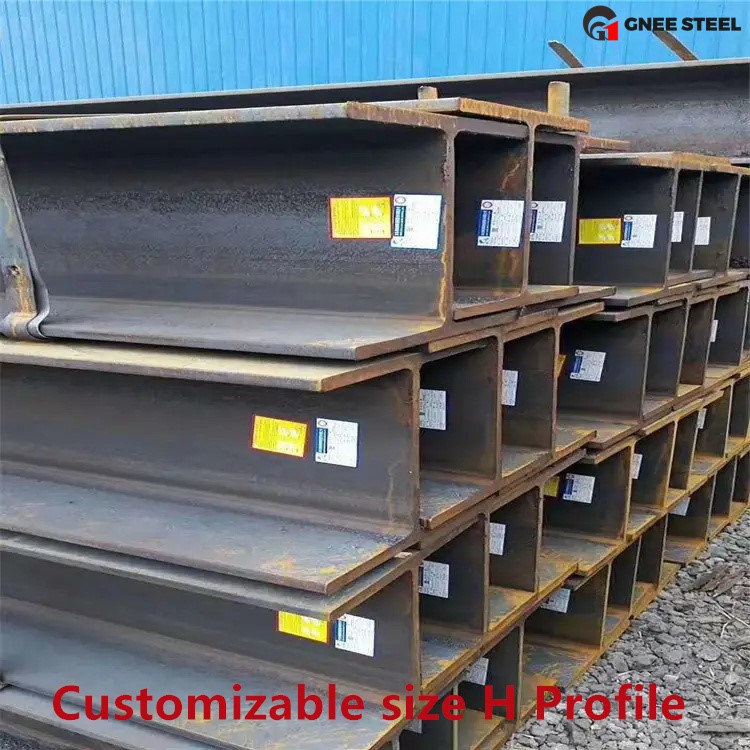
Customizable hot-rolled Q235B and Q355B steel H-beams are essential load-bearing structural components, specifically engineered to meet the diverse and flexible requirements of modern construction projects, ranging from residential and commercial buildings to industrial facilities and infrastructure development. Manufactured through advanced hot-rolling technology and adhering to Chinese national standards (GB/T 700-2006 for Q235B and GB/T 1591-2018 for Q355B), these H-beams combine superior mechanical properties, excellent processability, and customizable specifications, making them a reliable and cost-effective choice for various construction scenarios.
The core advantage of these H-beams lies in their use of two high-quality structural steel grades-Q235B and Q355B-each with distinct mechanical characteristics tailored to different load-bearing demands, ensuring optimal performance and safety in diverse project applications. Both grades are low-carbon structural steels, featuring good weldability, ductility, and formability, which are critical for on-site processing, assembly, and integration with other structural components.
Q235B is a widely used mild carbon structural steel, renowned for its balanced performance and cost-efficiency. It boasts a minimum yield strength of 235 MPa and a tensile strength range of 370-500 MPa, with excellent plasticity and toughness. This grade is designed to withstand medium loads and is suitable for general construction projects, including multi-story residential buildings, ordinary industrial workshops, bridge auxiliary structures, scaffolding, and secondary load-bearing components. Its moderate strength and easy processability make it ideal for projects where cost control and basic structural reliability are prioritized, and it can be easily cut, bent, welded, and drilled without requiring special preheating or processing techniques.
Q355B, a high-strength low-alloy (HSLA) structural steel, represents an upgraded alternative to Q235B, offering superior load-bearing capacity and structural stability. With a minimum yield strength of 355 MPa-approximately 51% higher than Q235B-and a tensile strength range of 470-630 MPa, Q355B delivers enhanced rigidity and impact resistance, even in low-temperature environments (tested at -20°C). This grade is specifically suited for heavy-duty construction projects, such as high-rise buildings, large-span industrial workshops, heavy equipment foundations, long-span bridges, and infrastructure projects that require higher safety reserves. By using Q355B H-beams, engineers can reduce the cross-sectional size of structural components, thereby lowering the overall self-weight of the structure, saving steel consumption, and optimizing project costs.
All Q235B and Q355B H-beams are produced via the hot-rolling process, a critical manufacturing technique that ensures exceptional product quality and structural integrity. During hot-rolling, steel billets are heated to high temperatures (typically 1100-1250°C) and passed through a series of rolling mills to form the characteristic H-shaped cross-section. This process refines the metal grain structure, eliminates internal defects (such as porosity and inclusions), and imparts uniform mechanical properties throughout the beam, resulting in stable dimensional accuracy, a smooth surface finish, and high durability. The hot-rolled H-shaped cross-section-featuring parallel top and bottom flanges and a central web-is optimized for stress distribution: the flanges bear bending moments, while the web resists shear forces, ensuring an excellent strength-to-weight ratio that outperforms traditional I-beams or solid steel columns.
A key distinguishing feature of these H-beams is their customizable design, which allows them to adapt to the unique requirements of different construction projects. Customization options include cross-sectional dimensions (flange width, web thickness, and beam depth), length (from standard lengths to custom-cut sizes), and surface treatments (such as hot-dip galvanizing, painting, or anti-corrosion coating) to enhance resistance to environmental wear and extend service life. This flexibility ensures that the H-beams can be tailored to fit specific design blueprints, whether for small-scale residential projects or large-scale industrial and infrastructure developments, eliminating the need for unnecessary material waste and optimizing construction efficiency.
These customizable hot-rolled H-beams are compatible with various construction methods, including cast-in-place construction, prefabricated modular assembly, and steel frame construction. Their flat, parallel flanges facilitate easy bolted and welded connections with other structural components, such as steel columns, node plates, sandwich panels, and floor slabs, reducing on-site construction time and labor costs. Additionally, both Q235B and Q355B steels are highly recyclable, with a scrap recycling rate of up to 90%, aligning with the principles of green and sustainable construction, which is increasingly prioritized in modern engineering projects.
Strict quality control measures are implemented throughout the production process, from raw material inspection and hot-rolling forming to dimensional testing and mechanical performance verification. Each batch of H-beams undergoes rigorous testing to ensure compliance with national standards for Q235B and Q355B, guaranteeing consistent quality, structural safety, and long-term service life. Whether used as main load-bearing beams, columns, or frame components, the customizable hot-rolled Q235B and Q355B steel H-beams provide a robust, flexible, and cost-effective structural solution, supporting the successful completion of diverse construction projects.