





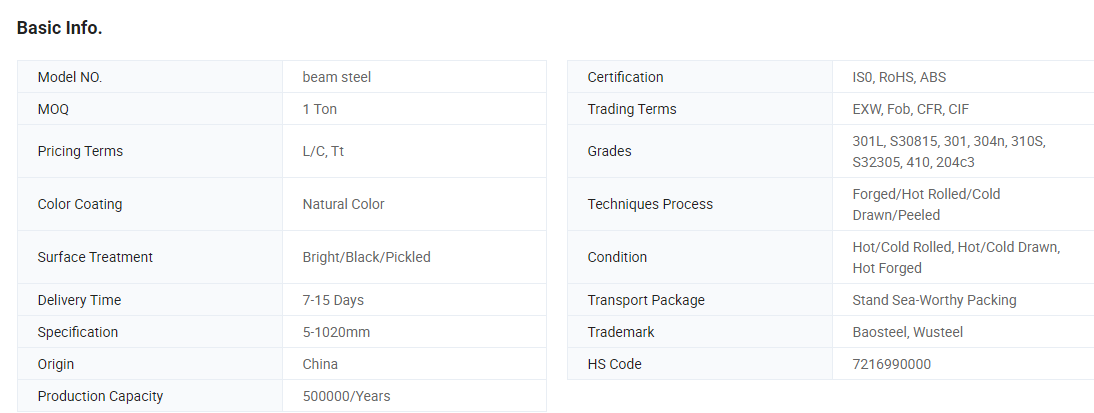
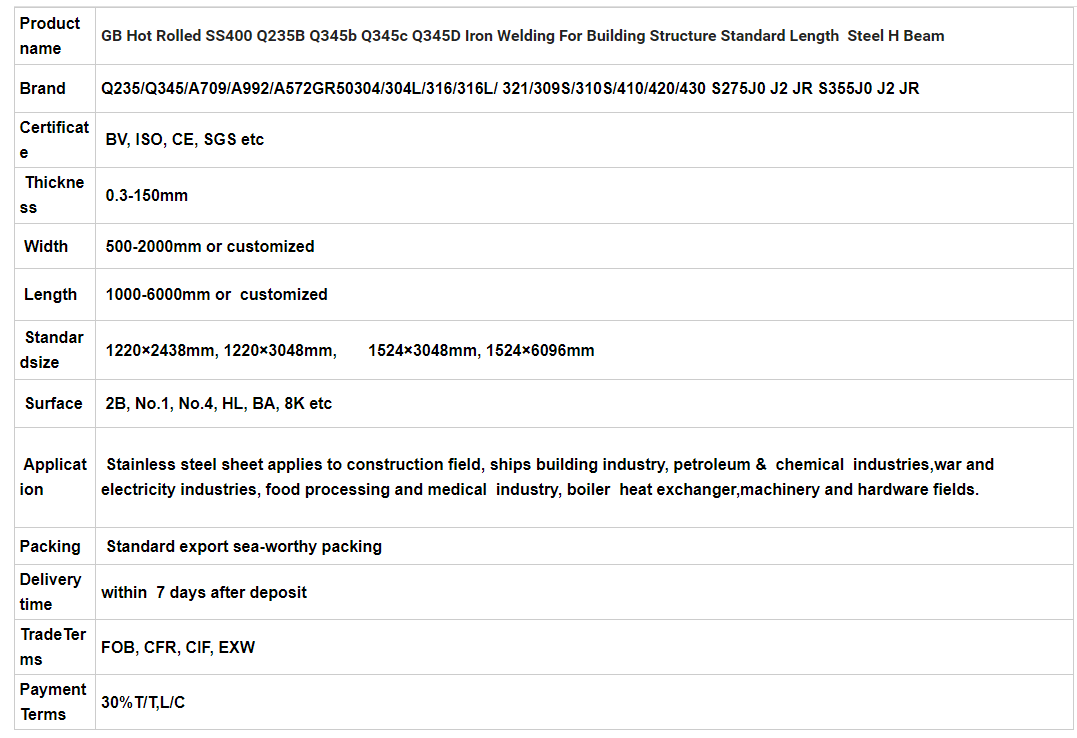
Stainless steel H beam size
| Size | Depth flange | Web | Flange thickness | Weight |
| width(mm) | thickness(mm) | (mm) | (kg/m) | |
| IPE100 | 100×55 | 4.1 | 5.7 | 8.1 |
| IPE120 | 120×64 | 4.4 | 6.3 | 10.4 |
| IPE140 | 140×73 | 4.7 | 6.9 | 12.9 |
| IPE160 | 160×82 | 5 | 7.4 | 15.8 |
| IPE180 | 180×91 | 5.3 | 8 | 18.8 |
| IPE200 | 200×100 | 5.6 | 8.5 | 22.4 |
| IPE220 | 220×110 | 5.9 | 9.2 | 26.2 |
| IPE240 | 240×120 | 6.2 | 9.8 | 30.7 |
| IPE270 | 270×135 | 6.6 | 10.2 | 36.1 |
| Grade | C | Si | Mn | P | Ni | Cr | Mo |
| 201 | ≤0.15 | ≤0.75 | 5.5-7.5 | ≤0.06 | 3.5-5.5 | 16.0-18.0 | - |
| 202 | ≤0.15 | ≤1.0 | 7.5-10.0 | ≤0.06 | 4.-6.0 | 17.0-19.0 | - |
| 301 | ≤0.15 | ≤1.0 | ≤2.0 | ≤0.045 | 6.0-8.0 | 16.0-18.0 | - |
| 302 | ≤0.15 | ≤1.0 | ≤2.0 | ≤0.035 | 8.0-10.0 | 17.0-19.0 | - |
| 304 | ≤0.08 | ≤1.0 | ≤2.0 | ≤0.045 | 8.0-10.5 | 18.0-20.0 | - |
| 304L | ≤0.03 | ≤1.0 | ≤2.0 | ≤0.035 | 9.0-13.0 | 18.0-20.0 | - |
| 309S | ≤0.08 | ≤1.0 | ≤2.0 | ≤0.045 | 12.0-15.0 | 22.0-24.0 | - |
| 310S | ≤0.08 | ≤1.5 | ≤2.0 | ≤0.035 | 19.0-22.0 | 24.0-26.0 | - |
| 316 | ≤0.08 | ≤1.0 | ≤2.0 | ≤0.045 | 10.0-14.0 | 16.0-18.0 | 2.0-3.0 |
| 316L | ≤0.03 | ≤1.0 | ≤2.0 | ≤0.045 | 12.0-15.0 | 16.0-18.0 | 2.0-3.0 |
| 321 | ≤0.08 | ≤1.0 | ≤2.0 | ≤0.035 | 9.0-13.0 | 17.0-19.0 | - |
| 630 | ≤0.07 | ≤1.0 | ≤1.0 | ≤0.035 | 3.0-5.0 | 15.5-17.5 | - |
| 631 | ≤0.09 | ≤1.0 | ≤1.0 | ≤0.030 | 6.50-7.75 | 16.0-18.0 | - |
| 904L | ≤2.0 | ≤0.045 | ≤1.0 | ≤0.035 | 23.0-28.0 | 19.0-23.0 | 4.0-5.0 |
| 2205 | ≤0.03 | ≤1.0 | ≤2.0 | ≤0.030 | 4.5-6.5 | 22.0-23.0 | 3.0-3.5 |
| 2507 | ≤0.03 | ≤0.80 | ≤1.2 | ≤0.035 | 6.0-8.0 | 24.0-26.0 | 3.0-5.0 |
| 2520 | ≤0.08 | ≤1.5 | ≤2.0 | ≤0.045 | 0.19-0.22 | 0.24-0.26 | - |
| 410 | ≤0.15 | ≤1.0 | ≤1.0 | ≤0.035 | - | 11.5-13.5 | - |
| 430 | ≤0.12 | ≤0.75 | ≤1.0 | ≤0.040 | ≤0.60 | 16.0-18.0 | - |
1.What is a galvanized steel beam?
Galvanized beams are structural steel beams that have been coated with a layer of zinc through a process called galvanization. Galvanization involves immersing the steel beam in a bath of molten zinc or applying a zinc coating through electroplating.
2.What is H-beam steel?
An h-beam is a steel structure that looks like its name suggests it should look: It's a steel beam shaped like a capital H. This structural beam made from rolled steel provides an impressive amount of strength when used in commercial building projects. Most of today's steel buildings use H-beams
3.Can steel beams be welded together?
Depending on the individual situation and the loadings involved, the structural engineer may specify one of several options to connect beams together and reduce torsion, such as: using bolts and spacers at regular centres. welding the beams together or providing a continuous welded plate over the top of both beams.
4.Do steel beams need to be galvanised?
Galvanizing is imperative in steel fabrication, particularly when the material is to be utilized in external environments or damp conditions, such as outdoor structures exposed to weather or within walls where moisture is prevalent. This finish is critical for enhancing the durability and corrosion resistance of steel.
5.What is another name for the H-beam?
H shapes are the largest and heaviest beams available and can tolerate larger weight loads. They are sometimes called HP, H-Piles, or bearing piles, which stems from their use in underground foundation support (load bearing columns) for skyscrapers and other large buildings.