


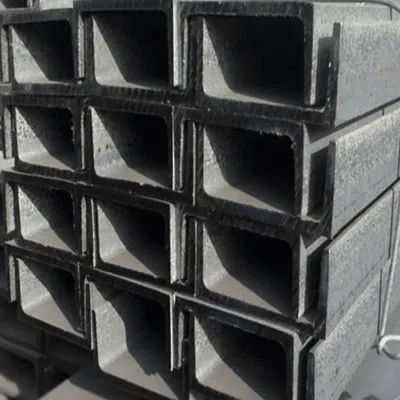


Set 1
What is hot-rolled carbon angle iron?
Hot-rolled carbon angle iron is a type of steel profile with an L-shaped cross-section, produced through a hot-rolling process. This method involves heating steel billets to high temperatures and then rolling them into the desired angle shape. The hot-rolling process enhances the material's ductility and workability, making it easier to form and shape. It is widely used in construction, machinery manufacturing, and structural applications due to its strength and versatility. The carbon content in hot-rolled angle iron contributes to its overall mechanical properties, ensuring it can withstand various loads.
What does S235JR refer to in carbon angle iron?
S235JR is a European standard structural steel grade commonly used in carbon angle iron. The "S" stands for structural steel, indicating its intended use in load-bearing structures. The number "235" refers to the minimum yield strength of 235 MPa, which means it can resist deformation under a certain amount of stress. The "JR" denotes that the steel is impact-tested at room temperature (20°C), ensuring it has adequate toughness for general structural purposes. This grade is popular in construction and engineering projects for its reliable performance and wide availability.
How does S275JR differ from S235JR in angle iron?
S275JR and S235JR differ primarily in their yield strength. S275JR has a higher minimum yield strength of 275 MPa, compared to 235 MPa for S235JR, making it stronger and more suitable for applications requiring greater load-bearing capacity. This higher strength means S275JR can withstand heavier loads without deformation. Additionally, while both are structural steels, S275JR may be preferred in projects where increased durability is necessary, such as in larger buildings or heavy machinery. However, S235JR is often more cost-effective for less demanding structural tasks.
What are the common applications of hot-rolled carbon angle iron?
Hot-rolled carbon angle iron is widely used in construction for framing, bracing, and supporting structures like buildings, bridges, and warehouses. It is also essential in machinery manufacturing, where it serves as components in equipment frames, brackets, and supports. In the automotive industry, it can be found in vehicle chassis and structural parts. Additionally, it is used in the fabrication of storage racks, shelving units, and industrial workbenches due to its rigidity and ease of installation. Its versatility makes it a staple in various industrial and commercial projects.
How is the size of carbon angle iron specified?
The size of carbon angle iron is typically specified by the lengths of its two legs and the thickness of the material. For example, a common specification might be "50x50x5 mm," where the first two numbers represent the length of each leg (50 mm each), and the third number is the thickness (5 mm). Sizes can vary, with leg lengths ranging from small (e.g., 20 mm) to large (e.g., 200 mm or more) depending on the application. The thickness also varies to accommodate different strength requirements, ensuring the angle iron can handle the intended load in specific projects.
Set 2
What advantages does hot-rolled carbon angle iron offer over cold-rolled versions?
Hot-rolled carbon angle iron has several advantages over cold-rolled types. The hot-rolling process results in a more ductile material, making it easier to cut, weld, and shape on-site, which is beneficial for custom fabrication. It also has a lower cost due to simpler production methods, making it more economical for large-scale projects. Additionally, hot-rolled angle iron typically has a rougher surface finish, which can improve paint adhesion, important for corrosion protection. Its mechanical properties are more consistent across the material, ensuring reliable performance in structural applications.
Is S235JR suitable for outdoor applications?
S235JR can be used in outdoor applications, but it requires proper protection against corrosion. Without treatment, its carbon steel composition is prone to rust when exposed to moisture and environmental elements. To enhance its durability outdoors, it is often painted, galvanized, or coated with anti-corrosive materials. Galvanizing, in particular, forms a protective zinc layer that prevents rust, making it suitable for outdoor structures like fences, signposts, and exterior building frames. With the right maintenance, S235JR can perform well in outdoor settings for many years.
What is the typical tensile strength of S275JR angle iron?
The typical tensile strength of S275JR angle iron ranges from 370 to 530 MPa. Tensile strength refers to the maximum stress the material can withstand before breaking under tension. This range is higher than that of S235JR (which usually has a tensile strength of 360 to 510 MPa), reflecting S275JR's greater overall strength. This higher tensile strength makes it suitable for applications where the angle iron will be subjected to significant pulling or stretching forces, such as in heavy-duty structural supports or machinery components.
Can hot-rolled carbon angle iron be welded easily?
Yes, hot-rolled carbon angle iron is generally easy to weld. Its hot-rolled nature results in a material with good weldability, as the high-temperature processing reduces internal stresses and creates a more uniform microstructure. Common welding methods like arc welding, MIG welding, and TIG welding work well with this type of angle iron. Proper welding techniques, such as using the correct filler material and controlling heat input, ensure strong and durable welds. This ease of welding makes it a preferred choice for fabricators and construction workers needing to join pieces on-site or in workshops.
What factors affect the price of carbon angle iron?
Several factors influence the price of carbon angle iron. The grade of steel, such as S235JR vs. S275JR, plays a role, with higher-strength grades often costing more. Size is another factor, as larger or thicker angle iron requires more raw material and production effort, increasing the price. Market conditions, including the cost of raw steel and supply-demand dynamics, can cause price fluctuations. Additionally, surface treatments like galvanizing or painting add to the cost, as they involve extra processing steps. Transportation and delivery costs may also impact the final price, especially for large or heavy orders.
Set 3
What is the maximum length available for hot-rolled carbon angle iron?
The maximum length of hot-rolled carbon angle iron typically ranges from 6 to 12 meters, depending on the manufacturer and supplier. Longer lengths are often available by special order to meet specific project requirements, such as large-scale construction or industrial applications. These longer pieces reduce the need for frequent joins, improving structural integrity and reducing installation time. However, handling and transporting longer lengths may require specialized equipment, which can affect overall project logistics and costs.
Does S275JR angle iron require special handling during fabrication?
While S275JR angle iron is durable, it does require some care during fabrication. Its higher strength compared to S235JR means it may require more powerful cutting tools, such as plasma cutters or heavy-duty saws, to achieve clean cuts. When welding, it is important to use appropriate welding parameters to avoid weakening the material, as excessive heat can affect its mechanical properties. Additionally, bending S275JR may require more force, and using proper bending equipment helps prevent cracks or deformation, ensuring the finished product meets design specifications.
What is the difference in weight between S235JR and S275JR angle iron of the same size?
For angle iron of the same size (same leg length and thickness), the weight of S235JR and S275JR is nearly identical. This is because both grades are made from carbon steel with similar densities, and their chemical compositions differ only slightly in terms of elements that affect strength, not density. The weight is primarily determined by the volume of the material, which depends on size. Therefore, a 50x50x5 mm angle iron will weigh the same whether it is S235JR or S275JR, making weight considerations irrelevant when choosing between these two grades for a project with fixed size requirements.
Can carbon angle iron be bent into custom shapes?
Yes, carbon angle iron can be bent into custom shapes, though the ease of bending depends on the grade, thickness, and desired bend radius. Hot-rolled angle iron, with its greater ductility, is more malleable than cold-rolled versions, making it easier to bend without cracking. Thinner angle iron bends more readily than thicker pieces, which may require heat to soften the material during the bending process. Specialized equipment like press brakes or rollers is used to achieve precise bends, ensuring the custom shapes meet the project's design needs, such as curved supports or angled brackets.
What standards govern the production of S235JR and S275JR angle iron?
S235JR and S275JR angle iron are produced according to European standards, specifically EN 10025-2. This standard specifies the technical delivery conditions for non-alloy structural steels, including requirements for chemical composition, mechanical properties (like yield strength and tensile strength), and testing methods. Compliance with EN 10025-2 ensures that these grades meet consistent quality and performance criteria across manufacturers, making them reliable for use in structural applications throughout Europe and in many international projects that adopt European standards.
Set 4
How does the thickness of carbon angle iron affect its load-bearing capacity?
The thickness of carbon angle iron directly impacts its load-bearing capacity. Thicker angle iron has a greater cross-sectional area, which allows it to distribute weight more effectively and resist bending or deformation under heavy loads. For example, a 5 mm thick angle iron can support more weight than a 3 mm thick one of the same leg length. This is because the additional material provides greater rigidity and strength, making thicker angle iron suitable for applications requiring high structural integrity, such as supporting heavy machinery or large building components. Thinner angle iron is often used for lighter-duty tasks like framing small structures or making brackets.
Is hot-rolled carbon angle iron magnetic?
Yes, hot-rolled carbon angle iron is magnetic. Carbon steel, which forms the base of this material, contains iron, a ferromagnetic metal, meaning it is attracted to magnets. The hot-rolling process does not alter this magnetic property, as it primarily affects the material's shape and mechanical properties, not its chemical composition. This magnetic characteristic can be useful in certain applications, such as temporary mounting using magnetic fixtures during fabrication, or in projects where magnetic properties are required for functional purposes.
What is the impact resistance of S235JR angle iron?
S235JR angle iron has good impact resistance, as indicated by the "JR" designation in its grade. This means it undergoes impact testing at room temperature (20°C) and must meet a minimum impact energy requirement (typically 27 J) to ensure it can absorb sudden forces without breaking. This makes it suitable for applications where the structure may experience unexpected impacts, such as in industrial settings with moving equipment or in buildings in areas prone to minor seismic activity. While it may not be as impact-resistant as higher-grade steels, it provides adequate toughness for most general structural uses.
Can S275JR angle iron be used in load-bearing structures?
Absolutely, S275JR angle iron is well-suited for load-bearing structures. With a minimum yield strength of 275 MPa, it can withstand significant vertical and horizontal loads, making it ideal for use in beams, columns, and bracing systems in buildings, bridges, and industrial facilities. Its higher strength compared to S235JR allows it to support heavier loads with smaller cross-sections, potentially reducing material costs and weight in the structure. Engineers often specify S275JR in projects where structural integrity under heavy loads is a priority, ensuring the safety and durability of the final construction.
How is carbon angle iron stored to prevent damage?
To prevent damage, carbon angle iron should be stored in a dry, covered area to avoid exposure to moisture, which can cause rust. If stored outdoors temporarily, it should be elevated off the ground using pallets or racks to prevent contact with water puddles and covered with a waterproof tarp. Angle iron should be stacked neatly, with supports placed at regular intervals to prevent bending or warping under its own weight, especially for longer lengths. Separating different sizes and grades helps avoid confusion during retrieval and reduces the risk of scratches or dents from mixing materials. Proper storage ensures the angle iron remains in good condition until it is ready for use.
Set 5
What is the chemical composition of S235JR angle iron?
S235JR angle iron has a specific chemical composition that contributes to its properties. It typically contains around 0.17-0.20% carbon, which provides strength without making the material too brittle. Manganese content ranges from 1.40% max, aiding in improving tensile strength and workability. Silicon is present up to 0.55% to enhance strength and deoxidize the steel. It also has small amounts of phosphorus (0.045% max) and sulfur (0.045% max), which are kept low to avoid reducing ductility and weldability. These elements work together to give S235JR its characteristic balance of strength, toughness, and ease of fabrication.
How does temperature affect the performance of hot-rolled carbon angle iron?
Hot-rolled carbon angle iron performs well under normal temperature conditions, but extreme temperatures can affect its properties. At high temperatures (above 300°C), its strength decreases, as the material softens, potentially reducing load-bearing capacity. Conversely, at very low temperatures, carbon steel can become more brittle, increasing the risk of cracking under impact, though grades like S235JR and S275JR are tested for low-temperature toughness (for JR grades, at 20°C). For applications involving extreme temperatures, additional measures like heat insulation or using specialized heat-resistant steels may be necessary to maintain performance.
What is the typical surface finish of hot-rolled carbon angle iron?
The typical surface finish of hot-rolled carbon angle iron is rough and scaled, a result of the hot-rolling process. During rolling, the high temperature causes a thin layer of oxide (scale) to form on the surface, which gives it a dull, matte appearance. This rough finish is beneficial for painting or coating, as it provides better adhesion for protective layers compared to the smooth surface of cold-rolled steel. While the scale can be removed through pickling or grinding if a smoother surface is needed, it is often left intact for structural applications where appearance is less critical than functionality.
Can S235JR and S275JR angle iron be used together in the same structure?
Yes, S235JR and S275JR angle iron can be used together in the same structure, depending on the design requirements. Engineers may specify S275JR for sections of the structure that bear heavier loads, while using S235JR for less stressed parts to optimize cost and performance. When combining them, it is important to ensure proper connection methods (like welding or bolting) that accommodate both grades, as their slightly different mechanical properties do not hinder compatibility. This approach allows for a balanced design that meets strength needs while potentially reducing overall material costs.
What testing is performed on carbon angle iron to ensure quality?
Carbon angle iron undergoes several tests to ensure quality. Mechanical testing includes tensile tests to measure yield strength and tensile strength, ensuring compliance with grade specifications (e.g., 235 MPa for S235JR). Impact tests, such as Charpy V-notch tests, evaluate toughness, particularly for JR grades tested at room temperature. Chemical composition analysis is done to verify the levels of carbon, manganese, and other elements meet standards. Dimensional checks ensure the angle iron's leg lengths, thickness, and straightness are within specified tolerances. These tests guarantee that the material performs as expected in its intended applications.


