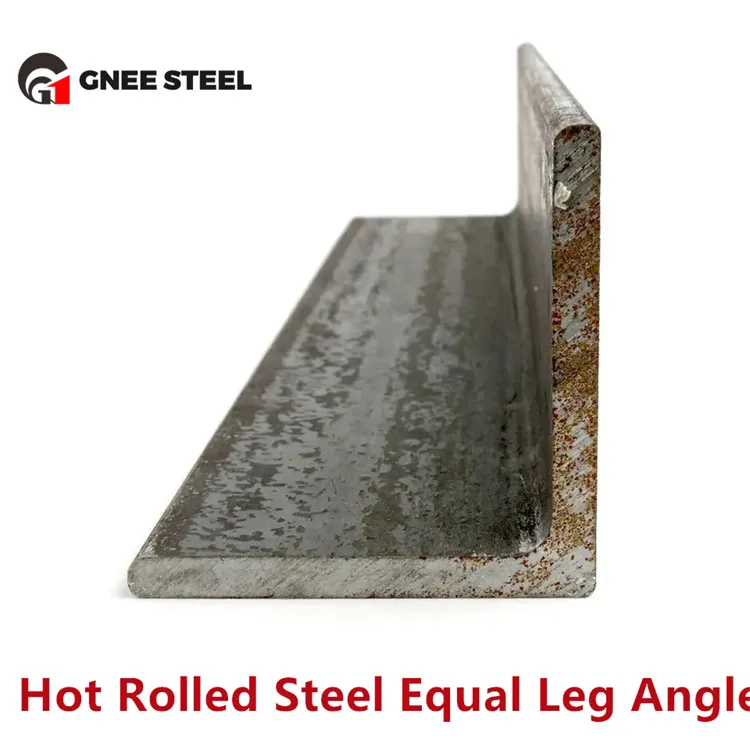
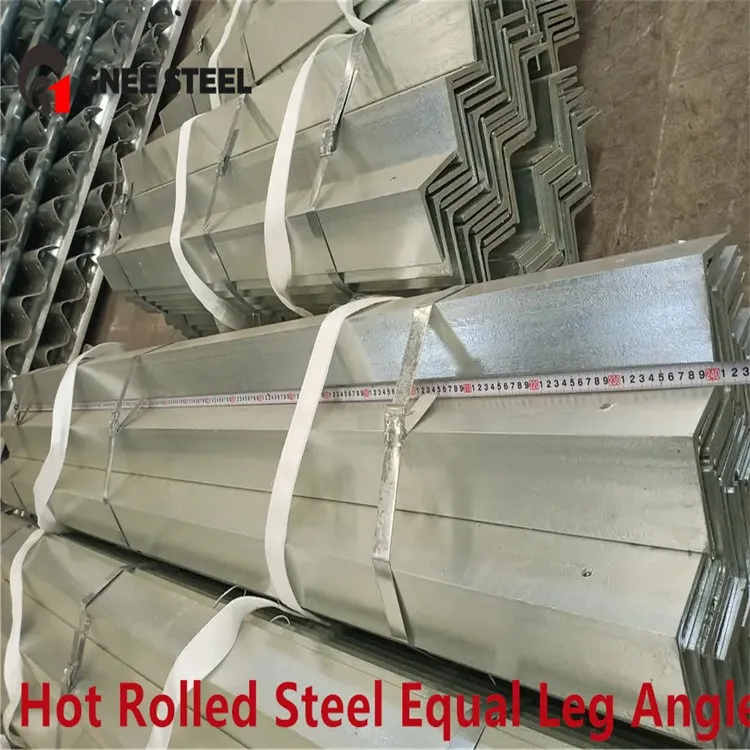
Set 1: Basics of Hot Sale Q235B, S235JR & S355JR Angle Steel
Question: What standards do Q235B, S235JR, and S355JR angle steels comply with, respectively?
Answer: Q235B adheres to China's GB/T 700-2006 standard for carbon structural steels, a widely used national standard in Chinese construction. S235JR follows the European EN 10025-2 standard, the primary specification for structural steels in the EU and many global markets. S355JR is also governed by EN 10025-2, designed as a high-strength low-alloy structural steel. These standards define chemical composition, mechanical properties, and quality requirements to ensure consistency. Compliance with these standards is key to their popularity, as they meet global construction and manufacturing codes.
Question: What do the designations "Q235B", "S235JR", and "S355JR" signify about each angle steel?
Answer: "Q235B" means "Q" (yield strength) with a 235MPa minimum yield strength, and "B" denotes impact testing at 20°C. "S235JR" stands for "S" (structural) with 235MPa yield strength, "J" (impact test at 20°C), and "R" (ordinary quality). "S355JR" indicates 355MPa minimum yield strength, "J" (20°C impact test), and "R" (ordinary quality). The numbers reflect yield strength differences, while letters specify toughness and quality grades. These designations help buyers quickly match the steel to project requirements.
Question: Are these angle steels available in equal and unequal leg designs, and why is that important?
Answer: Yes, Q235B, S235JR, and S355JR angle steels are produced in both equal and unequal leg configurations. Equal legs (e.g., 50×50×5mm) offer symmetric load-bearing, ideal for balanced structures like roof trusses and handrails. Unequal legs (e.g., 40×63×5mm) provide asymmetric strength, perfect for sloped roofs, beam-column connections, or machinery frames with uneven stress. Offering both designs makes them versatile for diverse projects-from residential construction to heavy industry. This flexibility is a key reason for their hot-sale status, as they cater to varied customer needs.
Question: What production process is used for these hot-sale angle steels, and how does it affect quality?
Answer: All three are manufactured via hot rolling-steel billets are heated to 1100-1250°C, then passed through rolling mills to form the angle shape. Hot rolling refines the grain structure, enhancing ductility and toughness critical for structural use. It allows precise control of leg dimensions and thickness, ensuring consistency across batches. The process is cost-effective for mass production, keeping prices competitive- a factor in their popularity. Hot rolling also creates a durable surface that handles fabrication (welding, bending) well, making them easy to work with for contractors.
Question: Why are Q235B, S235JR, and S355JR among the most hot-sale angle steels globally?
Answer: Their popularity stems from balanced performance and affordability-Q235B and S235JR are cost-effective for general use, while S355JR offers higher strength for heavy loads. They have excellent weldability and formability, reducing fabrication costs. Compliance with major global standards (GB, EN) makes them accessible in diverse markets. Their versatility suits projects from residential buildings to industrial machinery, appealing to a wide customer base. Additionally, mature production lines ensure stable supply and consistent quality, building buyer trust. These factors combine to drive high demand.
Set 2: Mechanical Properties Comparison
Question: How do the yield and tensile strengths of Q235B, S235JR, and S355JR angle steels differ?
Answer: Q235B has a minimum yield strength of 235MPa and tensile strength of 375-500MPa. S235JR matches Q235B closely: 235MPa yield and 360-510MPa tensile strength. S355JR offers significantly higher yield (355MPa) and tensile (470-630MPa) strengths. These differences target distinct applications-Q235B/S235JR for light-to-medium loads (e.g., residential frames), S355JR for heavy loads (e.g., bridge girders, crane booms). The strength gap allows buyers to optimize material selection: choosing lower strength for cost savings or higher strength for durability.
Question: What are the impact toughness requirements for these three angle steels, and why does it matter?
Answer: Q235B requires ≥27J impact energy at 20°C. S235JR needs ≥27J at 20°C (or 0°C for some subgrades). S355JR mandates ≥27J at 20°C. Impact toughness resists brittle fracture under sudden loads (e.g., wind gusts, machinery impacts). For cold-region projects, subgrades like Q235D or S355JO (lower temperature impact tests) are available, but the standard grades suit most ambient environments. Good toughness ensures structural safety, making these angle steels reliable for critical applications- a key selling point.
Question: How does the chemical composition of these angle steels influence their performance?
Answer: Q235B and S235JR are plain carbon steels with ≤0.22% carbon (ensuring weldability) and 0.30-1.60% manganese (boosting strength). S355JR adds small alloy elements (niobium, vanadium) to reach 355MPa yield strength, while keeping carbon low (≤0.22%) for weldability. Phosphorus and sulfur are limited to ≤0.045% in all three to prevent brittleness. Controlled composition ensures consistent mechanical properties-Q235B/S235JR balance cost and usability, while S355JR gains strength without sacrificing workability. This composition control is vital for meeting standard requirements and buyer expectations.
Question: Which of these angle steels offers the best formability, and how does that benefit fabrication?
Answer: Q235B and S235JR have slightly better formability (elongation ≥25%) than S355JR (elongation ≥21%), due to their lower strength and plain carbon composition. They bend easily without cracking, suitable for custom shapes like curved handrails or frame corners. S355JR still offers good formability for its strength class, handling most bending and rolling needs. All three can be cut, drilled, and welded with standard equipment-no specialized tools required. This ease of fabrication reduces labor time for contractors, making the angle steels more attractive for projects with tight deadlines.
Question: How do these angle steels perform under high-temperature conditions?
Answer: All three maintain strength at ambient temperatures, but performance declines above 300°C. Q235B and S235JR retain ~70% of their yield strength at 400°C, while S355JR retains ~65% due to its alloy content. None are recommended for continuous use above 425°C, as strength drops sharply. For short-term heat exposure (e.g., welding), they recover properties once cooled, as long as cooling is controlled. In fire scenarios, they require fireproofing (e.g., intumescent paint) to maintain structural integrity. Their high-temperature performance is sufficient for most non-industrial applications, aligning with their primary use cases.
Set 3: Application Scenarios by Grade
Question: What are the typical applications of Q235B angle steel, and why is it suited for them?
Answer: Q235B is widely used in Chinese residential construction for roof trusses, floor joists, and balcony supports-its 235MPa yield strength meets light-to-medium load needs. It makes agricultural equipment (greenhouse frames, tractor parts) due to affordability and formability. It is used for storage racks, shelving, and concrete formwork supports. In small-scale manufacturing, it builds machinery frames and tooling. Its compliance with GB/T 700 makes it the go-to choice for domestic projects, and its low cost appeals to budget-conscious buyers. Its weldability also simplifies on-site assembly for contractors.
Question: When is S235JR angle steel the preferred choice, and what industries rely on it?
Answer: S235JR is preferred in European and global projects requiring EN 10025-2 compliance, such as commercial building frames and warehouse structures. It is used for highway guardrails and railway bracing, where its toughness resists impact. The automotive industry uses it for trailer frames and non-critical chassis parts. It is common in DIY and architectural projects (railings, decorative elements) due to easy fabrication. Export-oriented manufacturers favor S235JR for its global recognition, as it meets standards in most international markets. Its balance of strength and cost makes it versatile for cross-industry use.
Question: What heavy-duty applications call for S355JR angle steel, and what advantages does it offer?
Answer: S355JR is used for high-rise building columns and long-span bridge bracing, where its 355MPa yield strength supports heavy loads. It builds crane booms and gantry crane structures, as its fatigue resistance handles dynamic loads. It is ideal for mining equipment (conveyor supports, crusher frames) and offshore platform components (with corrosion protection). Industrial machinery bases rely on it for rigidity and durability. Compared to Q235B/S235JR, S355JR allows lighter designs (thinner sections for same load), reducing material and transportation costs- a key advantage for large projects.
Question: Can these angle steels be used interchangeably, and what factors determine substitution?
Answer: Interchangeability depends on project requirements. Q235B and S235JR are nearly identical in mechanical properties, so they can substitute for each other in non-code-specific light-to-medium load projects. S355JR cannot replace Q235B/S235JR if cost is a priority, but it can substitute them for heavier loads (with material savings). Conversely, Q235B/S235JR should not replace S355JR in heavy-load applications, as they lack sufficient strength. Standards also matter-EU projects may require S235JR/S355JR, while Chinese projects mandate Q235B. Engineers must approve substitutions to ensure structural safety and code compliance.
Question: What corrosion protection is needed for these angle steels in outdoor applications?
Answer: All three are susceptible to rust outdoors, so protection is essential. Hot-dip galvanizing is most effective, applying a zinc coating that lasts 20-30 years in rural areas (10-15 years in coastal regions). Painting with anti-rust primer and acrylic topcoat is cost-effective for mild environments. For marine or industrial areas, a duplex system (galvanizing + epoxy coating) resists salt and pollutants. Zinc-rich paint touches up welds or damaged areas. Q235B/S235JR may need thicker coatings than S355JR in harsh environments, as they lack alloy-based corrosion resistance. Proper protection extends service life and maintains structural integrity.
Set 4: Production & Quality Control
Question: What steps are taken during production to ensure consistent quality of these hot-sale angle steels?
Answer: Production starts with high-quality billets-suppliers test billets for chemical composition to meet grade requirements. Reheating temperature is strictly controlled (1100-1250°C) to avoid over/underheating. Rolling mills use CNC controls to adjust leg dimensions and thickness, ensuring adherence to standards. After rolling, angle steels cool slowly on cooling beds to prevent residual stresses. Straightening machines correct bowing, and cutting lines produce precise lengths. Each batch undergoes sampling for mechanical and chemical tests. These steps ensure every piece meets quality standards, critical for maintaining hot-sale status.
Question: What quality tests are performed on Q235B, S235JR, and S355JR angle steels before shipment?
Answer: Tensile tests measure yield/tensile strength and elongation to verify mechanical properties. Impact tests (Charpy V-notch) check toughness at specified temperatures (20°C for all three). Chemical composition analysis (via spectrometry) confirms element levels meet standards. Dimensional inspections use calipers and straightness gauges to check leg length, thickness, and straightness. Surface inspections detect defects like cracks, pits, or scale. A material test certificate (MTC) is issued for each batch, documenting test results. Some manufacturers offer third-party inspections (e.g., SGS) for export orders to build buyer confidence.
Question: How do manufacturers ensure dimensional accuracy for these angle steels?
Answer: Manufacturers use precision-machined rolling rolls tailored to each angle size (equal/unequal). CNC systems monitor and adjust roll speed, pressure, and gap in real-time during rolling, maintaining tight tolerances (±0.5mm for leg length, ±0.1mm for thickness). Post-rolling, automated measuring systems scan angles to detect dimensional deviations. Straightness is ensured via roller straighteners with adjustable pressure, limiting bowing to ≤3mm/m. Regular calibration of rolling and measuring equipment (monthly) guarantees consistency. Any non-compliant pieces are rejected or reworked, ensuring buyers receive angles that fit design specifications.
Question: What measures are taken to prevent surface defects in these angle steels?
Answer: Billets are inspected and cleaned to remove scale or rust before reheating, preventing surface imperfections. Rolling mills use lubricants to reduce friction between rolls and steel, minimizing scratches. Controlled cooling prevents thermal cracking on the surface. After rolling, shot blasting may be used to remove residual scale, leaving a clean surface. Visual inspections (manual or automated) check for cracks, pits, or unevenness-defective pieces are discarded. Some manufacturers apply a thin oil coating to prevent rust during storage and transportation. These steps ensure the angle steels have a high-quality surface suitable for immediate fabrication.
Question: How do production lead times compare for Q235B, S235JR, and S355JR angle steels?
Answer: Lead times are similar for standard sizes (6m/9m/12m lengths), typically 3-7 working days for in-stock inventory. For large orders (over 50 tons) or custom sizes, lead times extend to 7-15 working days. Q235B may have shorter lead times in Chinese markets due to local production dominance, while S235JR/S355JR lead times depend on European/global production schedules. During peak construction seasons (spring/summer), lead times may increase by 2-3 days. Manufacturers prioritize hot-sale grades by maintaining higher inventory levels, ensuring faster delivery than specialty steels. This quick availability boosts their popularity among buyers with tight project timelines.
Set 5: Procurement & Practical Tips
Question: What should buyers consider when choosing between Q235B, S235JR, and S355JR angle steels?
Answer: First, match the grade to load requirements-Q235B/S235JR for light-to-medium loads, S355JR for heavy loads. Check project standards: Chinese projects may require Q235B, EU/global projects S235JR/S355JR. Factor in cost-Q235B/S235JR are cheaper than S355JR, so choose higher strength only if needed. Consider fabrication needs: Q235B/S235JR are slightly easier to bend, while S355JR suits welding with standard methods. Evaluate environmental conditions-all need corrosion protection outdoors, but S355JR's alloy content offers minor inherent resistance. Consult structural engineers to ensure the grade meets safety and code requirements.
Question: What packaging and shipping options are available for these hot-sale angle steels?
Answer: Angle steels are bundled with steel straps (2-4 straps per bundle) to prevent shifting. Small sizes (≤50×50mm) are bundled in 500-1000kg packs; larger sizes in 1000-2000kg packs. Wooden pallets or blocks pad the bottom of bundles to avoid damage. Domestic shipping uses flatbed trucks; international shipping uses cargo ships (containers for small bundles, bulk for large orders). Waterproof tarpaulins cover bundles for outdoor storage during transit. Suppliers offer custom packaging (e.g., plastic wrapping) for corrosion-sensitive orders. Shipping documents include MTC, packing list, and certificate of origin (for exports) to facilitate customs clearance.
Question: How to store these angle steels properly to prevent damage and rust?
Answer: Store in a dry, well-ventilated warehouse to avoid moisture. Stack bundles on wooden racks (15-30cm above ground) to prevent contact with damp floors. Separate grades and sizes with labels to avoid mixing. Cover with waterproof tarpaulins if stored outdoors, and use desiccants in enclosed storage. Avoid stacking too high (max 2-3 meters) to prevent bending. For long-term storage (over 3 months), apply anti-rust oil and inspect monthly-remove rust with a wire brush and reapply oil. Keep storage areas clean to prevent dust and debris buildup, which can trap moisture and cause rust.