


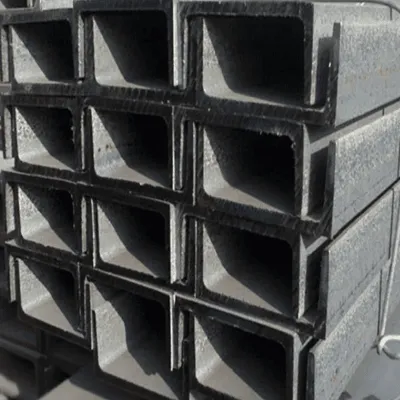


Why HEB Profiles Suit Multi Tier Growing Structures
A vertical farming structure is a steel rack carrying several tiers of growing beds, irrigation lines and lighting, usually inside a room with high humidity and frequent washdown as well as cold storage areas. The frame must be stiff enough to keep trays level, strong enough for the accumulated weight, and resistant to corrosion in an environment where a painted surface is difficult to maintain.
HEB profiles meet these requirements because the wide parallel flanges give a stable surface for bolted tier beams, the section is available in a dense ladder of sizes so that the lightest adequate profile can be selected, and the open geometry allows complete galvanizing with free drainage. Compared with a fabricated box column, a rolled HEB section needs fewer welds, which reduces both cost and the risk of coating defects.
HEB Section Dimensions and Mass
| Profile | Dimensional standard | h x b (mm) | t w (mm) | t f (mm) | Mass (kg/m) |
|---|---|---|---|---|---|
| HEB 120 | EN 10365 | 120 x 120 | 6.5 | 11 | 26.7 |
| HEB 160 | EN 10365 | 160 x 160 | 8 | 13 | 42.6 |
| HEB 200 | EN 10365 | 200 x 200 | 9 | 15 | 61.3 |
| HEB 300 | EN 10365 | 300 x 300 | 11 | 19 | 117 |
Up to about four tiers, HEB 160 or HEB 200 columns with HEB 120 or HEB 140 tier beams are common; taller installations with wide spans move to HEB 240 or HEB 300 columns. Mass per metre is used for estimating and transport, while the design check uses the section properties tabulated in the same standard.
Estimating Tier Loads
Tier load is the sum of the growing medium, the plants, the tray or trough, and the water held in the medium and in the irrigation lines. A saturated growing medium commonly weighs between 1.0 and 1.6 tonnes per cubic metre, so a bed 200 mm deep adds roughly 2.5 kilonewtons per square metre before the plants and the tray itself are counted. Lighting, cables and pipework add further dead load, and maintenance access adds a concentrated live load at the tray edge.
Because the frame is a rack rather than a floor, the governing case is often not a single tier but the accumulation of the loaded tiers above a column, combined with the horizontal force from tray impact during loading. Irrigation leaks and cleaning also mean that the steel is wet for long periods, which is why unprotected steel is unsuitable regardless of how low the stress is.
Deflection, Buckling and Design Standards
Members are designed to EN 1993-1-1 or an equivalent structural steel code, and the serviceability limit is usually set by the allowable deflection of the tier beam, typically between span divided by 200 and span divided by 300 depending on whether the beam supports rigid trays or flexible irrigation pipe. Excessive deflection tilts the growing bed, which causes uneven water distribution and reduces yield even though the frame is structurally safe.
Columns are checked for flexural buckling over the unbraced height between tiers and for the local buckling of the flange and web where the section is slender. Where a column is spliced between tiers, the splice is designed as a full strength connection with the same second moment of area as the parent section, because a partial strength splice will govern the sway behaviour of the whole rack.
Connections, Corrosion Protection and Hygiene
Tier beams are normally bolted to the column flanges with high strength structural bolts to EN 15048 or ASTM F3125, using cleats welded to the column in the shop. Welding is executed to EN 1090-2 at the class specified for the structure, and bolted joints are preferred on site because they avoid hot work inside a food production room.
Hot dip galvanizing to EN ISO 1461 is the standard protection, with a coating thickness related to steel thickness and complete coverage of internal corners because the section is open. Where the structure stands in a high humidity room with frequent washdown, a duplex system of galvanizing plus a suitable topcoat may be specified from the coating standard for the corrosivity category of the room. Zinc coated steel is not intended for direct contact with harvested produce, so trays or an interface layer isolate the crop from the frame, and drainage paths are arranged so that washdown water does not pond on the section.
Frequently Asked Questions
Q: Which HEB size is used for a six tier vertical farm?
A: A common arrangement is HEB 200 or HEB 240 columns with HEB 120 to HEB 160 tier beams, depending on the tier span and the weight of the saturated medium. The choice is confirmed by a frame analysis rather than by a rule of thumb, because the tier load, span and bracing layout all change the answer.
Q: Why are HEB profiles preferred over fabricated columns?
A: A rolled HEB profile is produced in a universal mill to a dimensional standard, so it has no longitudinal weld, requires no fabrication hours, and galvanizes cleanly with free drainage. A fabricated column can be lighter for a given load but needs welding, dimensional control and often additional coating inspection.
Q: Is galvanized steel acceptable in a food production area?
A: Hot dip galvanized framing to EN ISO 1461 is widely used for grow room structures, provided the crop or product does not contact the zinc coating directly. Where contact is possible, an additional coating or a stainless steel interface is used between the frame and the produce.
Q: How much deflection is acceptable for a tier beam?
A: A limit between span divided by 200 and span divided by 300 is typical, chosen so that the growing bed stays level enough for even irrigation. The limit should be agreed with the irrigation and tray supplier before the section size is fixed.
Q: Should the frame be bolted or welded on site?
A: Shop welded cleats with site bolted connections are the standard solution, because they avoid hot work and welding fumes in a production room and allow the rack to be dismantled if the layout changes. Site welding is reserved for repairs or for bracing added after commissioning.
Q: What standards apply to a vertical farming steel frame?
A: Sections are dimensioned to EN 10365, designed to EN 1993-1-1, fabricated to EN 1090-2, bolted with EN 15048 or ASTM F3125 fasteners and protected by hot dip galvanizing to EN ISO 1461. Where a paint system is added, the corrosion protection standard for the room corrosivity category applies.