


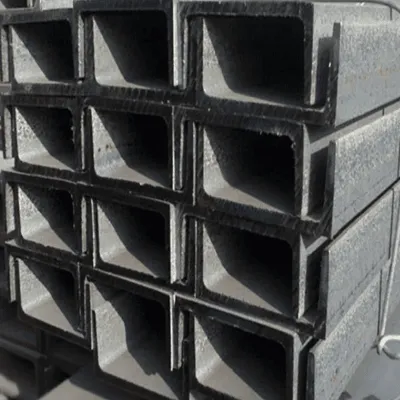


The production process of UPE/UPN European standard channel steel ensures quality through strict adherence to EN standards, standardized manufacturing steps, and rigorous testing-all aligned to guarantee consistency, performance, and compliance.
Core Quality Assurance Measures in Production
Raw Material Control
High-purity raw materials (iron ore, scrap steel) are selected and tested for chemical composition (per EN 10025-2) to avoid excess impurities (e.g., P ≤0.035%, S ≤0.035%). Suppliers must provide certificates of analysis, and mills conduct in-house spectroscopic testing to verify elements like carbon (max 0.24%), manganese (1.00–1.60%), and silicon (max 0.55%)-critical for strength and weldability.
Precision Hot RollingThe process starts with heating billets to 1100–1250°C for ductility, then passing them through calibrated rolling stands. Computer-controlled rolling mills ensure dimensional accuracy (per EN 10279), with real-time monitoring of height, flange width, and web thickness via laser gauges. This prevents deviations from tolerances (e.g., ±1.0 mm for heights ≤100 mm) and ensures uniform cross-sections-vital for load-bearing consistency. UPE's parallel flanges and UPN's tapered flanges are shaped via specialized dies to meet design specifications.
Controlled CoolingAfter rolling, channels undergo controlled cooling (air cooling or accelerated cooling for low-alloy grades) to avoid residual stresses and ensure uniform microstructure. Rapid cooling is avoided to prevent brittle phases (e.g., martensite), while slow cooling prevents grain coarsening-both critical for achieving the 355 MPa yield strength and 21% elongation required for S355JR.