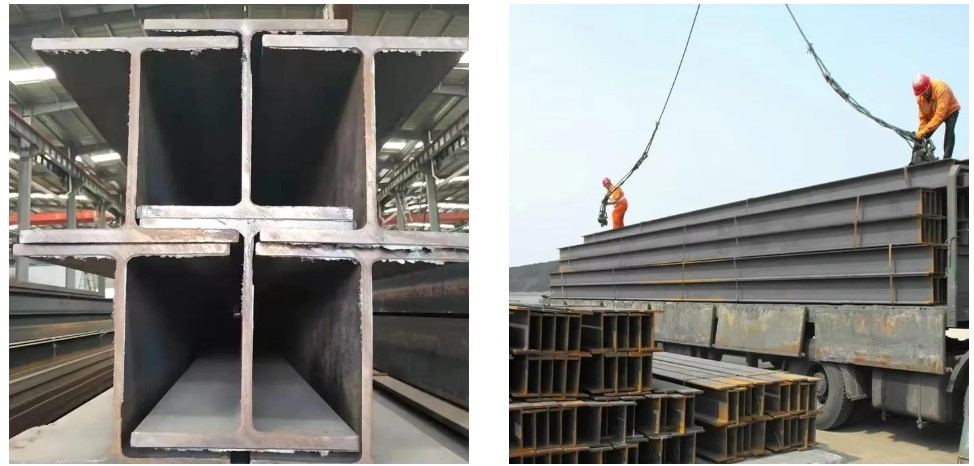
The width of an H-beam refers to the distance between the outer edges of its two flanges. It's measured horizontally across the top (or bottom) flange using a tape measure or caliper. For instance, an H200×100 beam has a width of 100mm. Widths vary with beam size: smaller beams have narrower flanges (80-150mm) for light loads, while larger ones (200-400mm) have wider flanges for better stability in heavy structures. Accurate width measurement ensures proper fit in steel frames.

What is the typical web thickness of H-beams?
Web thickness (the vertical middle part of H-beams) usually ranges from 6mm to 30mm. Small H-beams (e.g., H125×65) have thinner webs (6-10mm) to reduce weight for light applications. Medium beams (H250×125) have 10-18mm webs, balancing strength and weight. Large beams (H600×200) use 18-30mm webs for high load-bearing. Web thickness is critical for resisting shear forces; thicker webs enhance durability in structures like industrial cranes or high-rise columns.
Do H-beam sizes vary by standard?
Yes, H-beam sizes differ by regional standards. For example, the European EN 10025 standard has beams like HEA 100 (100×100×6×8), while the American AISC standard uses W14×34 (355×178×6×9). Chinese GB/T 11263 specifies HM 194×150×6×9. These variations include differences in height, width, flange thickness, and web thickness. Engineers must select beams matching the project's local standard to ensure compliance with building codes and structural safety.

What is the maximum flange thickness of common H-beams?
Common H-beams have a maximum flange thickness of around 50mm. For example, the large European HEB 1000 beam has flange thicknesses of 49mm, and the American W36×330 beam has flange thicknesses of 48.3mm. Thicker flanges (30-50mm) are found in heavy-duty H-beams used for bridges, power plant structures, or industrial buildings with high loads. Flange thickness directly impacts the beam's bending strength; thicker flanges improve resistance to bending forces.
Why are H-beams stronger than I-beams of similar size?
H-beams are stronger than I-beams of similar size due to their uniform flange thickness and wider web. H-beams have flanges with consistent thickness (no tapering), distributing weight evenly across the flange. Their web is also wider, enhancing shear strength. In contrast, I-beams have tapered flanges (thicker at the web, thinner at the edges), which reduces their load-bearing capacity. For example, an H200×100 beam can carry more vertical load than an I200×100 beam because its flanges better resist bending, making H-beams ideal for heavy structures.