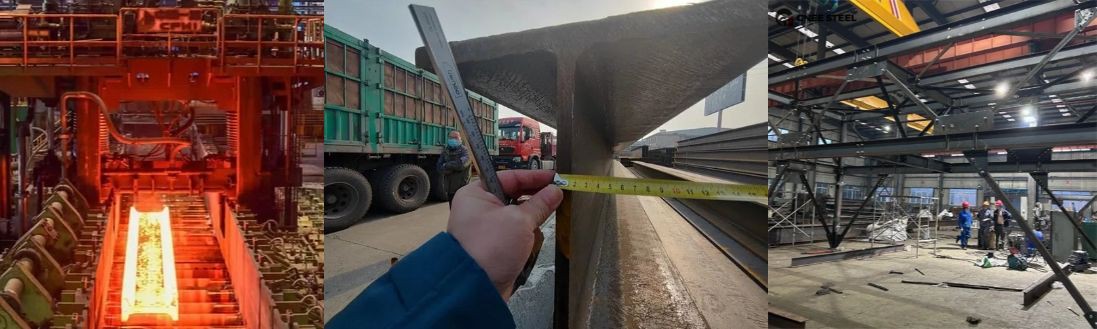
To ensure the quality of H - beam steel in outdoor structures exposed to sunlight, proper anti - corrosion and anti - UV measures should be taken. Using UV - resistant coatings or paint can prevent the degradation of the steel surface due to sunlight. Regular inspection and maintenance are also necessary to check for any signs of corrosion or surface deterioration caused by long - term exposure to sunlight.
1.What are the advantages of using H - beam steel in theaters and auditoriums?
In theaters and auditoriums, H - beam steel offers advantages such as enabling large - span, column - free spaces, which are ideal for creating unobstructed sightlines for the audience. It provides strong support for the roof and stage structures, including lighting and sound equipment. H - beam steel also allows for creative architectural designs to enhance the aesthetic appeal of the venue.
2.How to calculate the lateral - torsional buckling resistance of H - beam steel beams?
The lateral - torsional buckling resistance of H - beam steel beams can be calculated using relevant design formulas. These formulas consider the beam's cross - sectional properties, such as the width of the flanges, the height of the web, and the steel's mechanical properties. The length of the beam, support conditions, and the type of loading (e.g., uniform load, point load) are also taken into account to determine the beam's resistance to lateral - torsional buckling.
3.What are the design considerations for H - beam steel in museums?
In museums, design considerations for H - beam steel include providing stable and secure structural support for exhibits, which may have specific environmental and safety requirements. The steel's appearance should be designed to blend with or enhance the architectural style of the museum. Fire - proofing and anti - vibration measures are important to protect
4.What is the difference between H - beam steel and I - beam steel?
H - beam steel has wider flanges and a narrower web compared to I - beam steel. H - beam is typically used for heavier load - bearing structures due to its greater strength and stability. I - beam is more suitable for lighter structures where bending moments are less significant.
the exhibits from damage.