


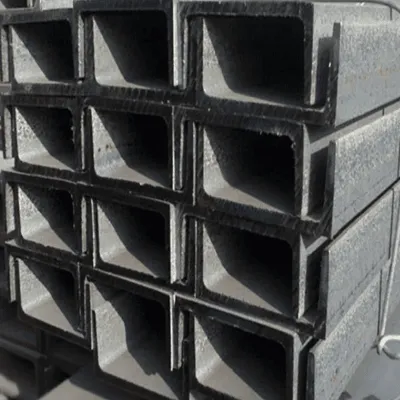


Q355D welded H-beams are widely used in industrial, structural, and infrastructure construction due to their excellent strength, weldability, and adaptability to customized project requirements.
Welded H-beams can undergo punching, branching, flame cutting, galvanizing, painting, and other fabrication processes, without affecting the inherent properties of the steel.
There are two main welding methods for welded H-beams:
High-frequency welding
Submerged arc welding (SAW)
These processes allow manufacturers to produce non-standard or large-section H-beams, offering great flexibility for engineering projects where hot-rolled H-beams cannot meet the dimensional requirements.
Compared with hot-rolled H-beams of the same weight, Q355D welded H-beams provide higher section modulus, section moment, pressure resistance, and load-bearing capacity, making them an economically optimized structural option.
Welding Characteristics
In a welding rod, the metal core wrapped in flux is called the weld core.
During H-beam welding, the weld core performs two essential functions:
Conducts welding current and generates an arc to transform electrical energy into heat.
Melts as filler metal, fusing with the base material to form a solid, high-strength weld.
These characteristics ensure the structural integrity and long-term stability of welded Q355D H-beams.
Chemical Composition (Hot Rolled)
| Steel Grade | Quality | C | Si | Mn | P | S | Cr | Ni | Cu | N |
|---|---|---|---|---|---|---|---|---|---|---|
| Q355B | B | 0.24 | 0.55 | 1.60 | 0.035 | 0.035 | 0.30 | 0.30 | 0.40 | 0.012 |
| Q355C | C | 0.20 | 0.55 | 1.60 | 0.030 | 0.030 | 0.30 | 0.30 | 0.40 | 0.012 |
| Q355D | D | 0.20 | 0.55 | 1.60 | 0.025 | 0.025 | – | – | – | – |
Carbon content limits for C and D grades:
C ≤ 0.20% when thickness ≤ 40 mm
C ≤ 0.22% when thickness > 40 mm
Chemical Composition (Normalized / Normalized Rolled)
Heat analysis, %
| Grade | Quality | C≤ | Si≤ | Mn | P≤ | S≤ | Cr≤ | Ni≤ | Cu≤ | Mo≤ | N≤ | Nb | V | Ti | Al≥ |
|---|---|---|---|---|---|---|---|---|---|---|---|---|---|---|---|
| Q355N | NB | 0.20 | 0.50 | 0.90–1.65 | 0.035 | 0.035 | 0.30 | 0.50 | 0.40 | 0.10 | 0.015 | 0.005–0.05 | 0.01–0.12 | 0.006–0.05 | 0.015 |
| NC | 0.20 | 0.50 | 0.90–1.65 | 0.030 | 0.030 | - | - | - | - | - | - | - | - | - | |
| ND | 0.20 | 0.50 | 0.90–1.65 | 0.030 | 0.025 | - | - | - | - | - | - | - | - | - | |
| NE | 0.18 | 0.50 | 0.90–1.65 | 0.025 | 0.020 | - | - | - | - | - | - | - | - | - | |
| NF | 0.16 | 0.50 | 0.90–1.65 | 0.020 | 0.010 | - | - | - | - | - | - | - | - | - |
Chemical Composition (Thermomechanically Rolled)
Heat analysis, %
| Grade | Quality | C≤ | Si≤ | Mn≤ | P≤ | S≤ | Cr≤ | Ni≤ | Cu≤ | Mo≤ | N≤ | Nb | V | Ti | Al≥ |
|---|---|---|---|---|---|---|---|---|---|---|---|---|---|---|---|
| Q355M | MB | 0.14 | 0.50 | 1.60 | 0.035 | 0.035 | 0.30 | 0.50 | 0.40 | 0.10 | 0.015 | 0.01–0.05 | 0.01–0.10 | 0.006–0.05 | 0.015 |
| MC | 0.14 | 0.50 | 1.60 | 0.030 | 0.030 | - | - | - | - | - | - | - | - | - | |
| MD | 0.14 | 0.50 | 1.60 | 0.030 | 0.025 | - | - | - | - | - | - | - | - | - | |
| ME | 0.14 | 0.50 | 1.60 | 0.025 | 0.020 | - | - | - | - | - | - | - | - | - | |
| MF | 0.14 | 0.50 | 1.60 | 0.020 | 0.010 | - | - | - | - | - | - | - | - | - |
Notes:
P and S may be 0.005% higher for bars and sections.
Ti content may reach 0.20% max.
