





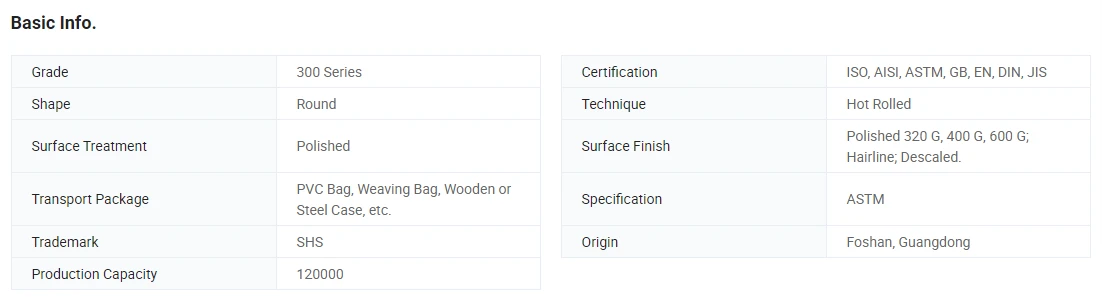
Product Description
| Item Name: | Stainless Steel Pipe (Tube) | ||||||||
| Standard: | ASTM A554 or A312 | ||||||||
| Grade of Material: | AISI 201, 202, 304, 304L, 316, 316L, etc. | ||||||||
| Certificate: | ISO 9001: 2008 | ||||||||
| Dimension: | (Rectangular)10mm X 20mm to 100mm X 200mm | ||||||||
| Surface: | Polished 600 G, 800 G. | ||||||||
| Length: | 10 mm - 10000 mm | ||||||||
| Packing: | Each or several tubes (pipes) would be sleeved in plastic bag individually, and then a bundle of them would be packed by a weaving bag which is seaworthy. | ||||||||
| Application: | Decoration, construction & building, such as handrail, railing, window, furniture, etc. | ||||||||
| Chemical Composition: |
Grade of Material | C | Si | Mn | P | S | Ni | Cr | Mo |
| AISI 201 | ≤0.15 | ≤1.00 | 5.50~7.50 | ≤0.060 | ≤0.03 | 1.00 ~1.50 | 13.50~15.00 | \ | |
| AISI 202 | ≤0.15 | ≤1.00 | 7.50~10.00 | ≤0.060 | ≤0.03 | 4.00~6.00 | 17.00~19.00 | \ | |
| AISI 304 | ≤0.08 | ≤1.00 | ≤2.00 | ≤0.045 | ≤0.03 | 8.00~11.00 | 18.00~20.00 | \ | |
| AISI 304L | ≤0.035 | ≤1.00 | ≤2.00 | ≤0.045 | ≤0.03 | 8.00~13.00 | 18.00~20.00 | \ | |
| AISI 316 | ≤0.08 | ≤1.00 | ≤2.00 | ≤0.045 | ≤0.03 | 10.00~14.00 | 16.00~18.00 | 2.00~3.00 | |
| AISI 316L | ≤0.035 | ≤1.00 | ≤2.00 | ≤0.045 | ≤0.03 | 10.00~14.00 | 16.00~18.00 | 2.00~3.00 | |
| Mechanical Property: |
Grade of Material | Elongation (%) | Tensile Strengh (Rm) N/m m³ | Yield Strength (Rp) 0.2%N/m m³ | Hardness (HV) | ||||
| AISI 201 | ≥35 | ≥520 | ≥210 | ≤253 | |||||
| AISI 202 | ≥35 | ≥590 | ≥210 | ≤218 | |||||
| AISI 304 | ≥35 | ≥520 | ≥210 | ≤200 | |||||
| AISI 304L | ≥35 | ≥480 | ≥180 | ≤200 | |||||
| AISI 316 | ≥35 | ≥520 | ≥210 | ≤200 | |||||
| AISI 316L | ≥35 | ≥480 | ≥180 | ≤200 | |||||
1. What is the difference between stainless steel pipe and tube?
What is the difference between stainless steel pipe and tube? The primary difference is shape and purpose. Pipes are always round and designed for transporting fluids and gas. Tubes can be round, square, rectangular, or oval, and are used for structural applications, precision, or aesthetic purposes.
2.What is the difference between 304 and 316 stainless steel tubing?
316 contains a minimum 2.0% molybdenum which makes it much more corrosion resistant than 304 however, as it is a more expensive element, generally makes 316 a more expensive grade of metal.
3.What is a stainless steel tube used for?
Stainless steel tubing is widely used in industrial and commercial settings where strength, hygiene, and corrosion resistance are critical. Common applications include: Gas and fluid transfer lines. High-pressure instrumentation.
4.Can 316 stainless steel rust?
The chromium in 316 steel creates a film on the surface that protects the metal from harsh conditions. This film can be damaged by scratching or other outside sources. One of the first signs of this process is surface rust. Surface rust isn't a problem.
5.How to bend a stainless steel tube?
Ridgid recommends using a stainless steel pipe bender that has long handles as this will give you the required leverage to bend the pipe or tube. The inclusion of rollers is another key design feature. These will easily glide around the tube as you bend it, making your job much easier.