


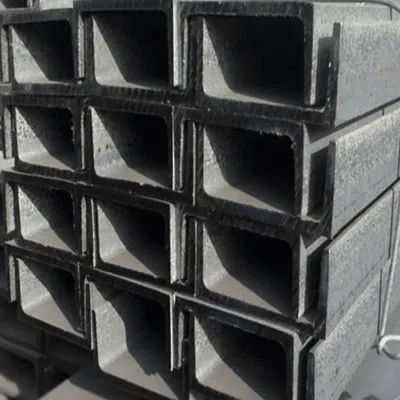


What Standard Size Means for Structural Steel H-Beams
A structural steel beam is bought against a standard size, never against a loose description. For hot rolled H-beams the standard size is expressed by four dimensions: overall height H, flange width B, web thickness t1 and flange thickness t2, written as H x B x t1 x t2. A designation such as 200 x 200 x 8 x 12 therefore describes a section 200 mm high and 200 mm wide, with an 8 mm web and 12 mm flanges.
Because the flanges are parallel and the section is doubly symmetric, an H-beam develops a high second moment of area about its strong axis for a given mass. That is why one standard-size family serves building frames, bridge girders, equipment skids and bracket structures, and why the size must always be quoted together with the steel grade and the surface finish.
Three designation systems appear on international drawings and purchase orders:
Metric dimensional designation - H x B x t1 x t2 in millimetres, applied to wide flange H-beams (HK), narrow flange H-beams (HZ) and H-beam piles (HU).
Imperial mass designation - W shapes quoted as depth x mass in pounds per foot, for example W8 x 10 or W6 x 20.
European profile series - IPE, HEA and HEB sections, whose dimensions and tolerances follow the EN 10365 and EN 10034 series.
Equivalent sizes from the three systems are not interchangeable without comparing web and flange thicknesses, local buckling slenderness and connection geometry.
Standard Size and Theoretical Weight Reference
| Designation | Height (mm) | Width (mm) | Web t1 (mm) | Flange t2 (mm) | Theoretical weight (kg/m) |
| W6 x 7 | 147 | 100 | 3.3 | 4.2 | 10.5 |
| W6 x 8.5 | 148 | 100 | 4.3 | 4.9 | 13.0 |
| W6 x 9 | 150 | 100 | 4.3 | 5.5 | 13.5 |
| W6 x 12 | 153 | 102 | 5.8 | 7.1 | 18.0 |
| W6 x 15 | 152 | 152 | 5.8 | 6.6 | 22.5 |
| W6 x 20 | 157 | 153 | 6.6 | 9.3 | 29.8 |
| W6 x 25 | 162 | 154 | 8.1 | 11.6 | 37.1 |
| W8 x 8 | 198 | 99 | 3.3 | 4.2 | 12.0 |
| W8 x 9 | 199 | 100 | 3.8 | 4.7 | 13.5 |
| W8 x 10 | 200 | 100 | 4.3 | 5.2 | 15.0 |
| W8 x 13 | 203 | 102 | 5.8 | 6.5 | 19.3 |
| W8 x 15 | 206 | 102 | 6.2 | 8.0 | 22.5 |
| W8 x 18 | 207 | 133 | 5.8 | 8.4 | 26.6 |
| W8 x 21 | 210 | 134 | 6.4 | 10.2 | 31.3 |
The theoretical weight of any of these standard sizes follows w = 0.785 x A, where w is the mass in kg per metre and A is the cross-sectional area in cm2, calculated as A = 2 x B x t2 + (H - 2 x t2) x t1. The formula ignores root radii and flange-to-web fillets, so the published nominal mass of a shape is typically 2 to 4 percent higher than the idealised figure, and the difference grows with section depth.
Nominal masses are listed slightly differently in GB/T 11263, EN 10365 and ASTM A6/A6M. When a project is priced per tonne, the mass basis has to be agreed with the supplier before the order is placed, because a small percentage difference across a few hundred tonnes is commercially significant.
Steel Grades and the Standards That Govern Them
ASTM A36/A36M - carbon structural steel for general construction, minimum yield strength 250 MPa.
ASTM A992/A992M - the standard shape grade for building frames, minimum yield strength 345 MPa, with a controlled yield-to-tensile ratio.
ASTM A572/A572M - high-strength low-alloy columbium-vanadium structural steel, including Grade 50, used for building and bridge girders.
ASTM A588/A588M - high-strength low-alloy weathering steel for exposed unpainted structures.
EN 10025-2 - non-alloy structural steels such as S235JR, S275JR and S355J0; EN 10025-5 covers the weathering grades S355J0W and S355J2W.
JIS G3101 - general structural rolled steel, including SS400; JIS G3192 gives the dimensions, mass and tolerances of hot rolled sections.
GB/T 700 - carbon structural steel including Q235B; GB/T 1591 covers Q355B; GB/T 11263 is the standard for hot rolled H-beams and cut T-sections.
ASTM A6/A6M - general requirements for rolled structural steel bars, plates, shapes and sheet piling, including permitted dimensional tolerances.
Grade must always be quoted together with the standard designation and, for low-temperature service or dynamic loading, with the impact test temperature and energy requirement. A grade name alone does not fix the toughness of the delivered material.
Galvanized or Black: Selecting the Surface Finish
Black, as-rolled beams carry mill scale and are suitable where the member is enclosed, dry and accessible for painting. Galvanized beams receive a hot dip coating after fabrication; coating mass, minimum local thickness and the steel chemistry limits that avoid coating defects are set by ISO 1461, ASTM A123/A123M and GB/T 13912.
Four issues decide the specification. The corrosivity category of the environment sets the coating class. The required service life sets whether a single coating is enough or whether a duplex coating is needed. The cost of future access sets whether repainting is realistic at all. Finally, the coating changes connection behaviour: bolted slip-critical connections on galvanized surfaces need a different surface treatment factor, and threaded fasteners must allow for coating thickness.
Galvanizing earns its premium in coastal, agricultural, outdoor and high-humidity installations, and in members whose flanges and web form a permanent drainage path. For a dry, heated, painted interior, black steel with a shop-applied paint system is normally the more economical choice.
How H-Beam Price Per Meter Is Calculated
Structural beams are quoted per tonne of theoretical weight, because the same standard size is rolled from several grades with different cost bases. Converting a per-tonne rate into a price per meter takes one line of arithmetic:
Price per meter = theoretical weight per meter in kg/m ÷ 1000 x price per tonne.
A 15.0 kg/m section contains 0.0150 t of steel per metre, so each unit change in the per-tonne rate moves the per-meter price by 0.0150. Finish surcharges and length supplements are usually quoted per tonne as well and are added to the base rate before the conversion, so the arithmetic stays consistent.
Three variables explain most of the spread between quotations for the same standard size: the steel grade, the surface finish, and the ordered length. Grade changes the feedstock cost, the finish adds coating mass and handling, and length determines how much of the mill's standard stock length is used. Comparing offers therefore means converting every quotation back to a per-tonne rate on the same grade, finish and weight basis, and separately comparing cut-length tolerances, straightness limits and the certification package.
A practical ordering checklist:
State the four dimensions in millimetres and name the designation series.
Quote the grade with its standard number and any impact testing requirement.
Specify the finish and, for galvanizing, the required coating class.
Agree the theoretical weight basis and the accepted mass tolerance.
Confirm length tolerance, straightness, marking and the mill test certificate package.
Frequently Asked Questions
Q: What is the difference between an H-beam and an I-beam?
An H-beam has parallel flange faces and a web whose thickness is close to that of the flanges, so it resists bending in both axes and accepts bolted connections easily. A conventional tapered-flange I-beam has sloped inner flange faces and a thinner web, which gives a lower capacity for the same nominal depth.
Q: How do I read a designation such as 200 x 200 x 8 x 12?
The four figures are overall height, flange width, web thickness and flange thickness in millimetres. The order never changes, and the grade is quoted separately, for example Q235B or SS400.
Q: Does galvanizing reduce the strength of an H-beam?
No. Hot dip galvanizing is a diffusion coating applied at a temperature below the phase transformation range of structural steel, so the specified yield and tensile properties are unaffected. The coating does require vent and drain holes in the detailing and must be allowed for at threaded and slip-critical connections.
Q: How much does an H-beam weigh per meter?
Use the theoretical weight from the standard size table, or calculate it as w = 0.785 x A, with A the cross-sectional area in cm2. The result is a nominal figure that excludes root radii, so it runs a few percent below the mass shown in the mill certificate.
Q: Which grades are commonly stocked for H-beams?
Q235B, SS400 and A36 cover general construction; S275JR, S355J0 and ASTM A992 are used where higher strength or tighter toughness control is needed; ASTM A588 and EN 10025-5 grades are specified for exposed weathering applications.
Q: Why does the price per meter differ between suppliers for the same size?
Usually because of grade, finish, ordered length or the weight basis used for the conversion. Normalising each offer to a per-tonne rate on identical grade, finish and theoretical weight removes most of the apparent difference.