


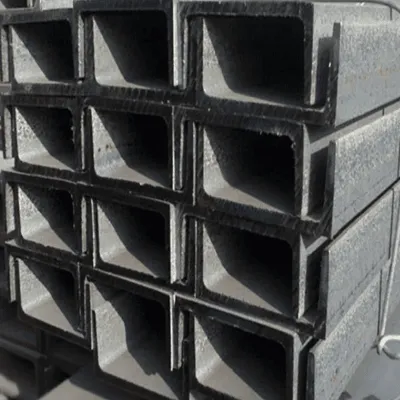


EN 10025-2 is the European delivery condition standard for hot-rolled non-alloy structural steels, and S275 is the strength class most often specified for UPN channel sections in general construction. Buyers frequently treat S275JR, S275J0 and S275J2 as interchangeable because the headline mechanical values look identical. They are not interchangeable, and the difference has direct consequences for low-temperature service, welding procedure qualification and material cost.
Common Ground: Strength and Mechanical Property Requirements
All three qualities must deliver a minimum yield strength Reh of 275 MPa for material up to 16 mm thick, falling to 255 MPa in the 16-40 mm range, and a tensile strength Rm of 410-560 MPa. A minimum elongation of 22 percent applies to the thickness range normally used for UPN sections. Where the qualities diverge is in toughness and in the chemistry needed to guarantee it.
Impact Testing: The Deciding Variable
The quality suffix defines the Charpy V-notch impact test temperature according to EN ISO 148-1. In all three cases the minimum absorbed energy is 27 J, tested in the longitudinal direction on full-size specimens.
| Quality | Impact test temperature | Minimum energy | Maximum sulfur |
|---|---|---|---|
| S275JR | +20 °C | 27 J | 0.035 % |
| S275J0 | 0 °C | 27 J | 0.030 % |
| S275J2 | -20 °C | 27 J | 0.025 % |
Because toughness at low temperature depends on steel cleanliness, the J0 and J2 qualities carry a lower maximum carbon content of 0.18 percent, against 0.21 percent for S275JR in the common thickness range, and correspondingly tighter phosphorus limits. This metallurgical tightening is the reason a J2 channel costs more than a JR channel of identical dimensions.
UPN Section Range, Dimensions and Tolerances
UPN channels are dimensioned according to EN 10365 and produced to the tolerances of EN 10279 for hot-rolled channels. Typical options in the S275 range are listed below with nominal mass.
| Designation | Height x width (mm) | Web thickness (mm) | Flange thickness (mm) | Nominal mass (kg/m) |
|---|---|---|---|---|
| UPN 100 | 100 x 50 | 6.0 | 8.5 | 10.6 |
| UPN 200 | 200 x 75 | 8.5 | 11.5 | 25.3 |
| UPN 300 | 300 x 100 | 10.0 | 16.0 | 46.2 |
Sections are supplied in lengths up to 12 m in the standard range, with cut-to-length, drilled and shop-primed options available when the fabricator prefers to receive pre-prepared material rather than process full bars.
Welding, Execution Class and Certification
All three qualities are readily weldable with conventional carbon-manganese consumables and no special preheat under normal plate thicknesses. Where the design service temperature falls below 0 C, or where impact and fatigue loading coincide with a welded joint, S275J2 should be specified rather than JR. Fabrication and erection should follow EN 1090-2, with weld acceptance levels defined against EN ISO 5817 and inspection documents issued as EN 10204 type 3.1. Structural steel kits placed on the European market require a declaration of performance and CE marking.
Practical Grade Selection for Buyers
Select S275JR for indoor framing, racking, platforms, stair stringers and general fabrication in temperate conditions. Select S275J0 for sheltered outdoor structures, transport equipment and moderate climates where occasional sub-zero exposure is expected. Select S275J2 for exposed low-temperature service, dynamically loaded structures, crane and lifting-related steelwork, and any welded detail where brittle fracture risk must be demonstrably controlled. On receipt, confirm three points on the mill certificate: the ordered quality designation, the recorded impact test temperature matched to that quality, and the sulfur and carbon values consistent with the quality ordered.
Frequently Asked Questions
Q: Do S275JR, S275J0 and S275J2 have the same yield strength?
A: Yes. All three require a minimum Reh of 275 MPa up to 16 mm thickness and an Rm of 410-560 MPa. The qualities differ only in impact toughness and chemistry limits.
Q: What does the letter suffix after S275 actually mean?
A: It states the Charpy impact test temperature. JR is tested at +20 C, J0 at 0 C and J2 at -20 C, with a minimum absorbed energy of 27 J in each case.
Q: Can S275JR be used instead of S275J2 for outdoor structures?
A: Only if the design temperature and fatigue assessment permit it. For exposed structures in cold climates or dynamically loaded details, J2 is the correct choice to control brittle fracture risk.
Q: Which standards govern UPN channel dimensions and tolerances?
A: Dimensions and section properties follow EN 10365 for hot-rolled channels, while dimensional tolerances are specified in EN 10279.
Q: What documentation should be supplied with a UPN channel order?
A: An EN 10204 type 3.1 inspection certificate showing heat number, chemical analysis, tensile results and the impact test temperature, plus a declaration of performance where the material is used in a structural kit under EN 1090-2.