





When sourcing structural sections, S355JR channel steel is one of the most popular choices due to its high yield strength, excellent weldability, and wide application range.
It is commonly used in steel buildings, machinery frames, bridges, and industrial fabrication projects. However, engineers and buyers often compare it with S355J0 channel steel when selecting materials for colder environments.

S355JR channel steel
Both grades fall under the EN 10025-2 standard and share a minimum yield strength of 355 MPa, but their performance in specific environments differs.
This guide explains the key differences between S355JR channel steel and S355J0 channel steel to help you make the right choice for your construction, fabrication, or machinery project.
Key Differences at a Glance of S355JR and S355J0 channel steel
The primary difference between S355JR and S355J0 channel steel lies in their Impact Toughness-the ability of the steel to resist fracture under sudden stress at specific temperatures. This property is especially important for outdoor structures, dynamic loads, and winter conditions.
S355JR Channel Steel: JR indicates that the material undergoes a Charpy V-notch impact test at +20°C (room temperature). It is the most cost-effective solution for standard indoor structures, mild outdoor climates, and general-purpose engineering applications.
S355J0 Channel Steel: J0 indicates that the impact test is conducted at 0°C. This grade offers better safety and toughness in colder environments, helping prevent brittle fracture when temperatures drop to the freezing point.
For projects exposed to seasonal cold weather, S355J0 structural channel steel can provide additional reliability.
Chemical Composition Comparison of S355JR and S355J0 channel steel
To achieve better low-temperature toughness, S355J0 channel steel typically has stricter controls on impurities like Phosphorus and Sulfur compared to S355JR channel steel. Lower impurity levels improve weld quality, crack resistance, and toughness.
| Grade | C (Max %) | Si (Max %) | Mn (Max %) | P (Max %) | S (Max %) | Cu (Max %) |
|---|---|---|---|---|---|---|
| S355JR | 0.24 | 0.55 | 1.60 | 0.035 | 0.035 | 0.55 |
| S355J0 | 0.20 | 0.55 | 1.60 | 0.030 | 0.030 | 0.55 |
Note: S355J0 channel steel's lower Carbon (C) and Phosphorus (P) content enhances its weldability, structural toughness, and resistance to cracking during fabrication.
Mechanical Properties of S355JR and S355J0 channel steel
While both grades provide the same strength, their performance under impact loading is what sets them apart.
| Grade | Yield Strength (ReH MPa) | Tensile Strength (Rm MPa) | Elongation (A% Min) | Impact Test Temp | Impact Energy |
|---|---|---|---|---|---|
| S355JR | 355 | 470-630 | 22 | +20 °C | 27 J |
| S355J0 | 355 | 470-630 | 22 | 0 °C | 27 J |
Both grades are considered high-strength structural channel steel, suitable for welded steel frames, support beams, and industrial load-bearing systems.
Choosing Between S355JR and S355J0 Channel Steel
Why choose S355JR Channel Steel?
Cost-Efficiency: It is generally more affordable than J0 and J2 grades, making it ideal for projects with budget control requirements.
Versatile Applications: Perfect for general building structures, warehouse frames, fencing, machinery supports, and steel fabrication, where extreme cold is not a factor.
Availability: As a standard grade, S355JR channel steel is usually available in a wider range of sizes, such as UPN channel steel, UPE channel steel, and PFC channel sections.
Easy Processing: Suitable for welding, drilling, cutting, punching, and galvanising.
Why upgrade to S355J0 Channel Steel?
Safety in Cold Climates: If your project is located in a region with cold winters, S355J0 channel steel provides an extra layer of structural security.
Heavy-Duty Loading: Recommended for structures subject to dynamic loads, repeated stress, or vibration at low temperatures.
Improved Toughness: Better crack resistance for demanding engineering conditions.
Why Partner with Gnee for S355JR Channel Steel?
Gnee Steel Group is a leading supplier of high-tensile structural steel sections. We maintain a massive inventory of S355JR Channel Steel in various dimensions to meet your immediate project needs and export requirements.
Diverse Inventory
We stock UPE Channel Steel (Parallel Flange) and UPN Channel Steel (Tapered Flange) from 50mm to 400mm, with multiple wall thicknesses and custom lengths available.
Precision Processing
We offer CNC cutting, punching, drilling, bending, welding, painting, and Hot-Dip Galvanising services to provide ready-to-install components.
Quality Certified
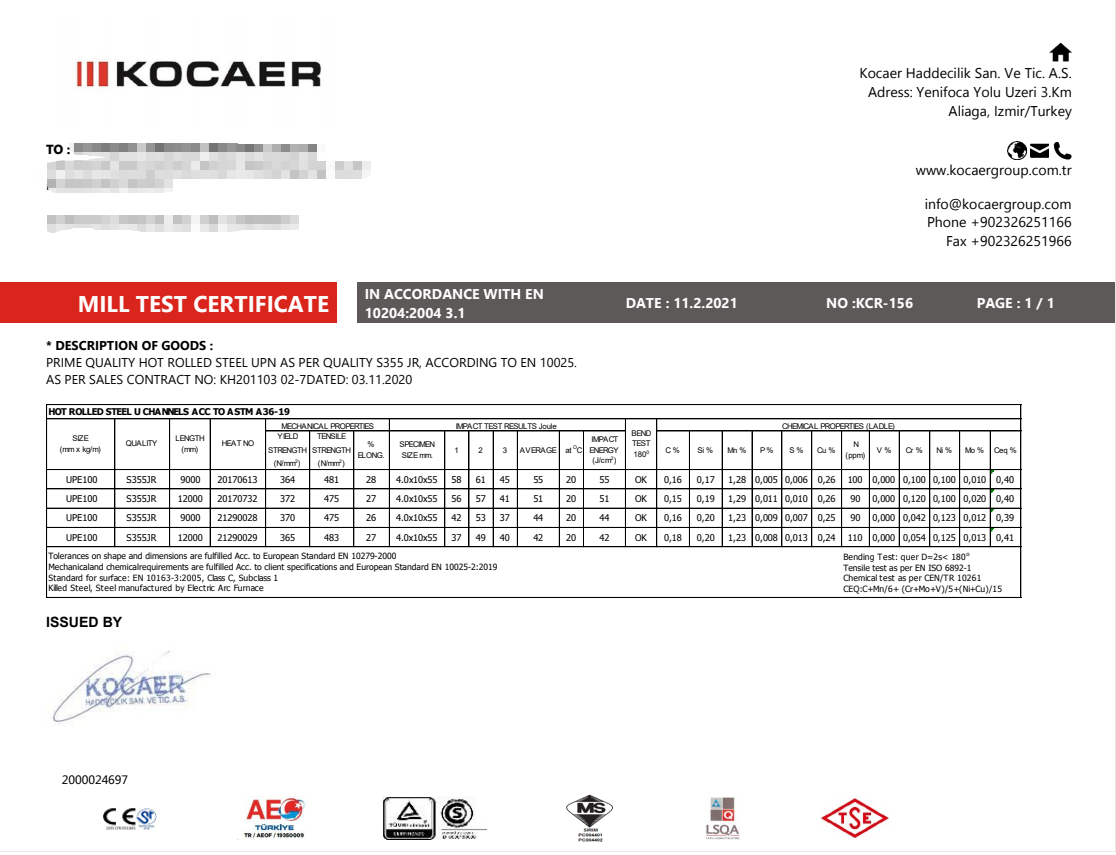
All our S355JR channel steel products come with EN 10204 3.1 Mill Test Certificates. We also support third-party inspections by SGS, BV, or DNV.
Global Logistics
Efficient shipping from Tianjin and Shanghai ports ensures your materials arrive on time, anywhere in the world. Standard sea-worthy export packing is available for containerised shipment.
Technical Support
Our team can help you choose the correct S355JR, S355J0, or S355J2 channel steel grade based on climate, load conditions, fabrication requirements, and project budget.
Contact Gnee Steel Group today for competitive pricing, stock availability, and technical support on S355JR channel steel, S355J0 channel steel, UPE channels, UPN channels, and all structural steel sections.
Contact now to get S355jr Channel Steel Quote

What is the US equivalent of S355JR?
Both grades are often interchanged in international projects, but equivalence is not absolute. According to industry sources, A36 is frequently cited as the closest American equivalent to S235JR (a lower grade), while S355JR is more comparable to ASTM A572 Grade 50 due to higher strength.
What does S355JR mean?
Steel grade S355JR is used to manufacture hot-rolled flat and long products, which are subsequently used when producing steel building structures. Classification: Non-alloy structural steel. Products: Flat and long products, semi-finished products.
What is the difference between S355JR and A36?
EN 10025-2 S355JR and ASTM A36 are both fundamental structural steels, but they are not direct equivalents. S355JR offers significantly higher yield strength (355 MPa vs. 250 MPa) and guaranteed impact toughness, aligning it more closely with ASTM A572 Grade 50.
What is the ASTM equivalent of s335jr?
The most widely accepted and functionally equivalent ASTM equivalent to S355JR is ASTM A572 Grade 50. Both are high-strength, low-alloy (HSLA) structural steels used extensively in construction, bridges, and general fabrication.
What is the difference between S355JR and S355MC?
Strength level: S355JR steel usually has a minimum yield strength of 355MPa, and its tensile strength is 470-630MPa when the thickness is less than 16 mm. In comparison, S355MC steel has a higher yield strength, usually 355-510MPa, and a tensile strength of 430-550MPa.