


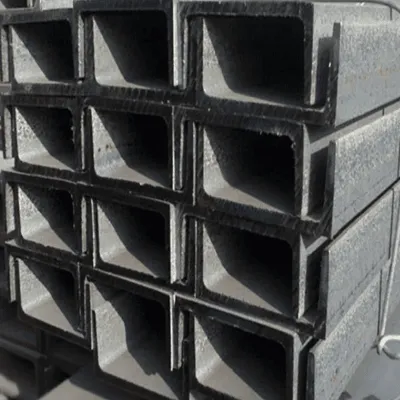


What Determines the Service Life of Channel Steel
Channel steel does not have a fixed service life. The real life of a channel in a structure is set by three factors: the corrosiveness of the environment, the quality of the protective system, and the nature of the loading. A channel that is kept dry, painted and lightly loaded can remain in service for 50 years or more, which is why carbon steel frames are routinely designed for 50-year design lives under EN 1990 and similar codes. The same channel exposed to coastal salt spray without protection could show serious corrosion within a few years.
Corrosion Environments and Their Effect
International standard ISO 9223 classifies atmospheric corrosivity into categories from C1 to CX:
C1 to C2, dry indoor and mild rural atmospheres, cause very slow corrosion of carbon steel, often under 25 microns per year.
C3, urban and mild industrial atmospheres, give moderate corrosion rates that require a decent paint system.
C4 and C5, industrial and coastal atmospheres, corrode unprotected carbon steel quickly and demand heavy-duty coatings or galvanizing.
The corrosion rate of bare steel also depends on humidity, temperature and pollution, and it is highest where steel stays wet for long periods.
Protection Systems That Extend Life
The most effective way to extend channel steel life is to control corrosion from the start:
Hot-dip galvanizing to ISO 1461 gives a zinc coating whose life is roughly proportional to its thickness; typical coatings on sections provide decades of protection even in C3 atmospheres.
Paint systems with zinc-rich primers, intermediate coats and topcoats protect outdoor structures when applied and maintained correctly.
Duplex systems, galvanizing plus paint, give the longest life in severe environments.
Indoor structures in dry atmospheres may need only a shop primer or light paint.
Cut edges, drilled holes and weld areas are the weak points and must be repaired with zinc-rich paint after fabrication.
Loading, Fatigue and End of Life
Channels under static loads rarely reach a material failure; they are retired because of corrosion, overloading or functional change. However, channels in cyclic service, such as crane rails, conveyor supports or vibrating machinery bases, can fail by fatigue even with negligible corrosion. For fatigue-loaded channels, the design must check the detail category of the connections, avoid sharp notches, and inspect welds regularly. In most buildings, the practical end of life is corrosion reaching a depth that reduces the section below its required capacity.
Inspection and Maintenance Strategy
To achieve a long service life, schedule periodic inspections of the coating condition, especially at connections, edges and water-trapping details. Touch up damaged paint promptly, keep drainage holes clear, and remove debris that holds moisture against the steel. A simple maintenance routine converts an expected life of 20 to 30 years into 50 years or more, and it costs a small fraction of replacement.
Frequently Asked Questions
Q: How long does channel steel last indoors?
In a dry indoor environment with a basic paint or primer, channel steel commonly serves for decades and can easily exceed 50 years before any significant corrosion appears.
Q: Does galvanizing extend the life of channels?
Yes, hot-dip galvanizing to ISO 1461 typically provides decades of maintenance-free protection, with the exact life depending on the coating thickness and the atmospheric corrosivity class.
Q: What is the biggest risk to channel steel life?
Corrosion in humid, industrial or coastal environments is the biggest risk, followed by fatigue for channels under repeated loading.
Q: How is atmospheric corrosivity classified?
ISO 9223 defines corrosivity categories from C1, very mild, to CX, extreme, and the category guides the selection of coating systems and expected corrosion rates.
Q: Can a corroded channel be repaired instead of replaced?
Light surface corrosion can be cleaned and recoated, but section loss beyond the design allowance requires an assessment and usually replacement of the affected member.