


When evaluating structural materials, professional buyers are not just asking what A572 H Beam is - they are asking whether A572 H Beam is suitable for their specific application.

A572 H Beam
Different industries impose different performance requirements. Below is a scenario-based technical breakdown of where A572 H Beam delivers the most value.
Solar Industry (PV Structures & Piling Systems)
In photovoltaic projects, A572 H Beam is widely used for foundation piling and support structures.
Key Requirement: Wind Load Resistance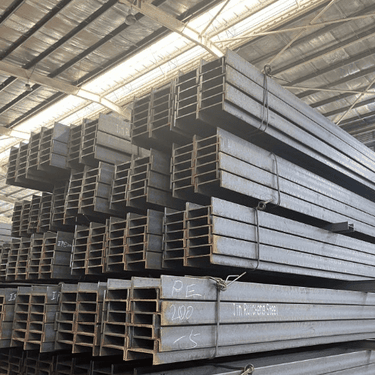
Solar farms are typically located in open environments where wind loads are a major design factor. The high yield strength of A572 H Beam allows structures to:
- Resist bending under strong lateral wind forces
- Maintain alignment of solar panels over long spans
- Reduce long-term deformation
Engineering Value
By using A572 H Beam, designers can reduce the number of support points while maintaining structural integrity. This leads to:
- Lower total steel usage
- Faster installation
- Improved project cost efficiency
A572 H Beam is an ideal choice for wind-resistant and cost-efficient solar mounting systems.
Bridge Engineering (Fatigue Resistance & Welding Reliability)
Bridge structures are exposed to continuous cyclic loading from traffic and environmental forces.
Key Requirement: Fatigue Performance
A572 H Beam provides:
- Strong resistance to fatigue cracking
- Stable performance under repeated stress cycles
- Long-term structural reliability
Welding Performance
Due to its low carbon equivalent, A572 H Beam ensures:
- Reduced risk of weld cracking
- High joint integrity
- Consistent welding quality across large structures
A572 H Beam is a reliable material for bridge girders and structural frameworks requiring long service life and safety.
Industrial Warehousing (Long Span Structures)
Industrial buildings and warehouses often require large clear spans and high load-bearing capacity.
Key Requirement: Wide Flange Efficiency
The geometry of A572 H Beam provides:
- Excellent torsional resistance
- Improved load distribution
- Stability under eccentric loading conditions
Practical Benefits
Using A572 H Beam enables:
- Column-free large interior spaces
- Support for heavy equipment and storage systems
- Efficient integration of crane systems and mezzanine floors
A572 H Beam is the preferred structural solution for long-span industrial applications.
Low-Temperature Applications (CVN Impact Requirements)
Low-temperature environments introduce a critical risk: brittle fracture.
The Engineering Concern
At low temperatures, structural steel may lose toughness, increasing the risk of sudden failure.
CVN Testing Requirement
For projects using A572 H Beam in cold environments, it is often necessary to specify:
- Charpy V-Notch (CVN) impact testing
- Minimum impact energy requirements based on service temperature
Typical Applications
- Bridges in cold regions
- Offshore structures
- High-altitude infrastructure
If your project involves low temperatures, A572 H Beam should be supplied with verified CVN impact properties to ensure safety and compliance.

A572 H Beam is a versatile structural material, but its true value depends on correct application:
- Solar projects benefit from its wind resistance and strength
- Bridge engineering relies on its fatigue and welding performance
- Industrial structures utilize its wide flange efficiency
- Cold environments require CVN-tested A572 H Beam

Selecting the right specification of A572 H Beam ensures better structural performance, lower lifecycle costs, and improved project reliability.
Contact now to get A572 Gr.50 H Beam Quote
Contact us to get a complete A992 and A572 Gr.50 structural steel H Beam selection guide and ensure your project meets both performance and inspection requirements.
What is A572 GR 50 material?
Grade 50 is a Columbium-Vanadium steel that offers a minimum yield of 50,000 PSI. In addition, ASTM A572 Grade 50 is noted for its increased resistance to atmospheric corrosion.
Is A572 grade 50 formable?
A572-50 steel is less formable than other grades of A572, but for the most part it has good formability, weldability, and machinability.
Is A572 grade 50 the same as A36?
Similar to A36, it utilizes carbon and manganese for strength, but it also includes additional alloys such as columbium or vanadium. These extra alloys boost its overall strength, making A572-50 typically priced at around 2.5% - 5% higher than A36.
Is A572 grade 50 equivalent to S355?
ASTM has identified A572-50 as an acceptable substitution for S355. Both grades have similar chemical compositions and are high-strength, low-alloy structural steels.